
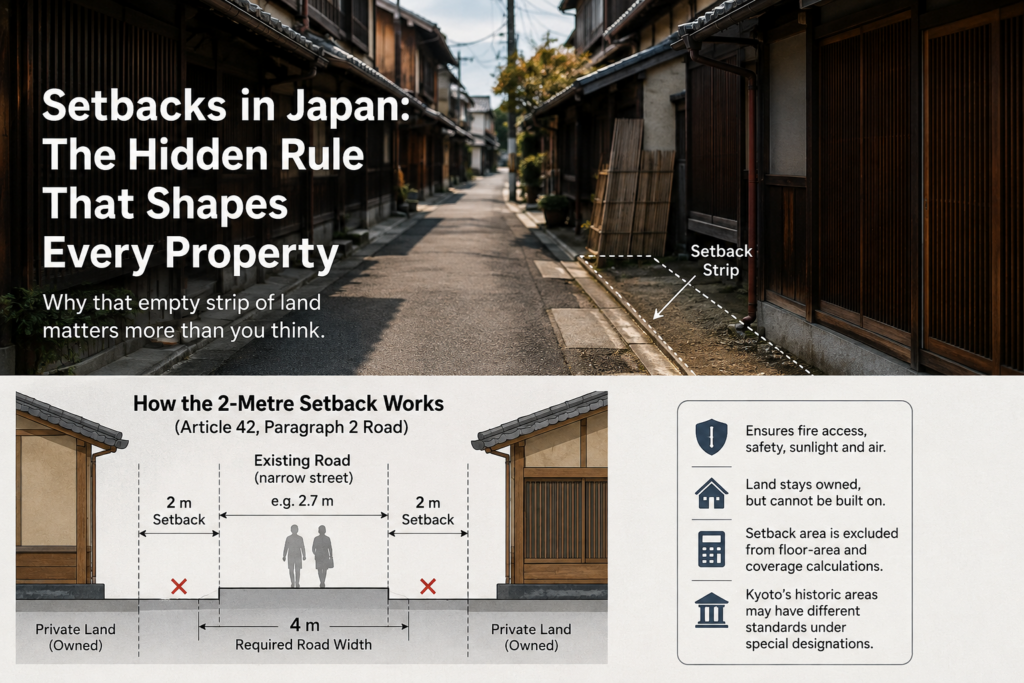
We were standing on a quiet side street in eastern Kyoto last spring, looking at a vacant machiya that had sat empty for years. The road was barely wider than a delivery van. On one side the wooden eaves almost touched those of the neighbor. On the other, a thin strip of concrete had been left open — no fence, no planter, just bare space that clearly belonged to the house but could never be built on.
That strip is a setback. And in Japan it is one of the quietest, most consequential forces shaping what you can actually do with a piece of land.
The national rule: four metres or nothing
Under Japan’s Building Standards Act, a building site must front a road that is at least four metres wide, and the frontage itself must be at least two metres long. This is the famous “road access obligation” (接道義務). Emergency vehicles need to reach the property. Fire needs room to be fought. Sunlight and air need a chance to move.
Plenty of older streets never met that standard. So the law created a compromise: Article 42, Paragraph 2 roads, often just called “2-item roads” or “deemed roads.” These are the narrow lanes that already had buildings along them when the law (or the local urban planning zone) took effect. They are treated as legal roads even if they measure only 2.5 or 3 metres across.
The price of that legal status is the setback. When you rebuild or substantially renovate, you must treat a line drawn two metres from the centre of the existing road as the new property boundary for building purposes. Everything on the road side of that line is off-limits for walls, gates, eaves, or structures. Ownership of the land usually stays with you, but for floor-area ratio and building-coverage calculations the setback strip is no longer counted as site area. In effect, the house gets smaller or the usable garden shrinks.
If the opposite side of the road is a river, a cliff, or a railway, the entire four-metre burden can fall on one owner. That is when the setback really starts to bite.
What this means for the property line you thought you owned
On paper the registered boundary may still run to the middle of the old lane. In practice, the buildable line has moved inward. The difference is not theoretical. We have measured more than one property where the usable depth dropped by a metre or more once the setback was enforced. On a narrow Kyoto lot that can be the difference between a workable house and a house that feels permanently compromised.
The setback land cannot be fenced off or turned into private parking. It is expected to remain open and passable, part of the future public right-of-way even while title remains private. Some municipalities will later purchase or accept the strip; many never do. The land sits in a permanent legal half-light.
Kyoto’s special case: narrow streets as cultural infrastructure
Kyoto has more of these narrow streets than almost any other Japanese city of its size. The historic core was never comprehensively redeveloped after the war the way Tokyo or Osaka were. Whole neighbourhoods still operate on lanes that would be illegal to create today.
That creates a tension the city has tried to manage rather than erase. Full enforcement of the two-metre centre-line setback would eventually open every historic alley to four metres. The continuous wall of wooden façades, the intimate scale, the play of light between opposing eaves — all of it would slowly disappear. Kyoto decided that outcome was not acceptable.
In designated historic narrow streets (歴史的細街路), particularly in parts of Gion and a few other carefully chosen areas, the city has used Article 42, Paragraph 3 of the Building Standards Act to set a different standard. The required setback is reduced or the road is treated under special conditions that allow the existing tight frontage to remain. The trade-off is stricter fire-safety and structural rules on the buildings themselves. The streetscape is protected; the individual building carries more responsibility for not burning the neighbourhood down.
Beyond the pure setback rules, Kyoto’s landscape and scenic ordinances add another layer. In many scenic districts and aesthetic zones the city requires additional wall setbacks from both the road and neighbouring boundaries — sometimes 1.5 to 3 metres — specifically to reduce visual bulk, protect views of the surrounding hills, and keep new construction from overwhelming traditional street proportions. These are not national safety rules. They are aesthetic and cultural rules written into local law.
So when someone asks whether Kyoto’s setbacks exist “to preserve the aesthetics,” the honest answer is yes — but only in certain designated places, and only as a deliberate exception to the national safety-driven system. Everywhere else, the four-metre logic still applies.
Why it matters if you own or plan to buy
We see the practical consequences regularly. A buyer falls in love with a quiet machiya on a charming lane, only to discover at the due-diligence stage that any rebuild will cost them a significant slice of the already small site. An overseas owner inherits a family house and assumes the boundary shown on the old survey is the buildable line. It is not.
The setback also affects value. Land that must surrender frontage is worth less than land on a full-width road. Appraisal reports will note it. Banks will note it. Future buyers will note it.
At the same time, the very restrictions that constrain rebuilding are part of what keeps these neighbourhoods distinctive. The same rules that frustrate a modern floor plan also prevent the wholesale replacement of human-scaled streets with the wider, more anonymous roads common in newer Japanese suburbs.
What we look for when we walk a property
When we inspect a vacant house or advise an overseas owner, the first thing we check is the status of the frontage road. Is it a full Article 42-1 road, a 2-item road, or something more complicated? Has a previous owner already set the line back, or is the obligation still waiting? Are there local scenic or historic designations that change the calculation?
Those questions determine how much of the land is truly usable, how expensive any future work will be, and whether the character of the street is likely to survive the next generation of rebuilds.
The setback is invisible until you need to build. Then it becomes the most important line on the property.
Read More
If you’re looking at property in Kyoto or the wider Kansai region, these related guides may help:
Japan Zoning Laws: What Property Buyers Need to Know
A clear overview of how zoning, use categories, and building restrictions shape what you can actually do with land in Japan.
Two Houses a Day: Kyoto Is Quietly Erasing Its Machiya
How the pressure of modern regulations and economics is changing Kyoto’s traditional wooden townhouses street by street.
Property Management in Japan for Foreign Owners (2026)
What overseas owners need to understand about the legal and practical realities of holding property from abroad.
12 Traditional Tools That Make a Machiya Feel Authentic
The small details that still define a real Kyoto machiya — and why they matter when the street frontage itself is under pressure.
Need Help Managing Your Property in Japan?
Property Management Kyoto helps overseas owners look after Japanese homes, vacant houses, and akiya across Kyoto, Shiga, Osaka, Nara, and Kobe.
If you’re considering a purchase, dealing with a rebuild, or simply want a clear picture of how setbacks and local rules affect your property, contact us for a free consultation. We can walk the site with you — or for you — and explain exactly where the buildable line sits.