
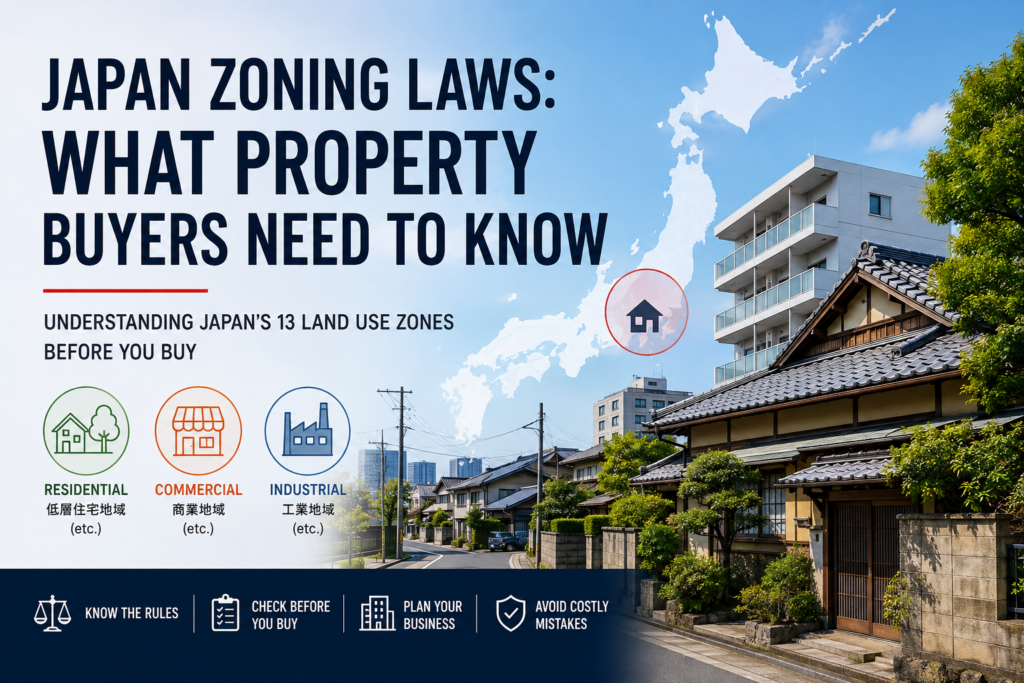
Japan is one of the more accessible real estate markets for foreign buyers. Foreigners can generally own land and buildings in Japan, but owning a property doesn’t necessarily mean you can use it however you want.
If you’re thinking about turning a house into a restaurant, guesthouse, office, rental property or other business, one of the first things to investigate is the property’s 用途地域 (yōto chiiki) — its designated land use zone.
Japan’s zoning system determines what types of buildings and businesses can operate in an area, how large a building can be, and how densely land can be developed.
For overseas buyers, this is an important part of due diligence. A property might look perfect for your plans, only for the zoning, building regulations or local rules to make those plans difficult or impossible.
At Property Management Kyoto, we help overseas property owners understand the practical issues involved in owning and managing property in the Kansai region.
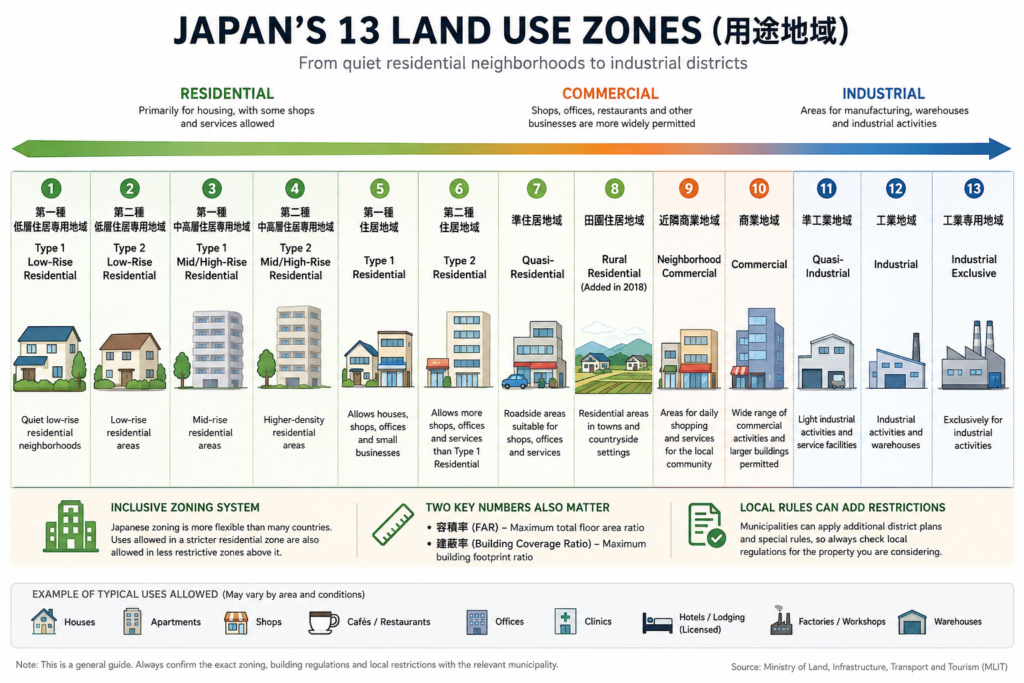
Japan Has 13 Main Land Use Zones
Japan’s land use system currently has 13 main 用途地域 (yōto chiiki) categories.
They can broadly be divided into three groups:
- Residential zones — areas primarily intended for housing, although many also allow limited shops, offices and other uses.
- Commercial zones — areas where shops, offices, restaurants and other businesses are more widely permitted.
- Industrial zones — areas intended for manufacturing, warehouses and other industrial activities.
The important thing to understand is that Japanese zoning is generally more flexible than a simple “residential = houses only” system.
Even in residential areas, certain shops, clinics, offices and other businesses can be permitted. The restrictions become progressively less restrictive as you move toward commercial and industrial zones.
Why Japanese Zoning Is Different
One of the interesting features of Japanese zoning is that a residential designation does not necessarily mean an area will contain only houses.
For example, a residential neighborhood may also contain small shops, restaurants, clinics or offices, depending on the particular zoning category and the size and nature of the proposed use.
This creates the mixed-use neighborhoods that are common throughout Japanese cities.
You might walk down a quiet residential street and find a small café, dentist, hair salon or convenience store nearby. That isn’t necessarily an exception to the zoning system — it can be exactly how the system is designed to work.
This flexibility is one reason Japanese neighborhoods can change gradually over time without requiring every individual property to undergo a complete zoning change.
But flexibility doesn’t mean anything goes.
The specific zone, building size, proposed use and local regulations all matter.
Two Numbers Property Buyers Should Know
The name of the zoning area isn’t the only thing that matters.
Two other numbers can have a major effect on what you can do with a property.
Floor Area Ratio — 容積率
容積率 (yōsekiritsu) is the floor area ratio.
It determines the maximum total floor area that can generally be constructed in relation to the size of the land.
For example, if a property has 200 m² of land and a permitted floor area ratio of 200%, the theoretical maximum total floor area would be 400 m², subject to other building regulations.
This can have a major impact on:
- Apartment development
- Number of rental units
- Extensions and rebuilding
- Commercial buildings
- Hospitality projects
Building Coverage Ratio — 建蔽率
建蔽率 (kenpeiritsu) controls how much of the land can be covered by the building’s footprint.
For example, a 60% building coverage ratio on a 200 m² site would generally allow a maximum building footprint of 120 m².
The combination of 容積率 and 建蔽率 can therefore be just as important as the zoning designation itself.
How Zoning Can Affect Your Business Plans
If you’re buying Japanese property for a particular purpose, zoning should be checked before you commit to the purchase.
Restaurants and cafés
Small restaurants and cafés can be permitted in a number of residential zones, but the exact conditions depend on the zone, floor area and type of business.
A small café in a residential neighborhood may therefore be perfectly legal, while a much larger restaurant or entertainment business may not be.
Offices
Small offices can be permitted in residential areas, but larger office developments generally require more permissive zoning.
Hotels and accommodation
Hotels, ryokan and other licensed accommodation businesses are subject to specific building-use restrictions as well as separate licensing requirements.
This is particularly important for buyers considering an older house or akiya as a guesthouse.
Factories and workshops
Industrial and quasi-industrial zones provide considerably more flexibility for manufacturing and workshop uses.
However, even industrial areas can have restrictions, and Industrial Exclusive (工業専用地域) is particularly important to understand because residential use is generally not permitted there.
Zoning Isn’t the Only Rule
This is one of the most important points for foreign property buyers.
Finding out that a property is in a particular zoning category is only the beginning of the investigation.
Municipalities can apply additional planning controls, including district plans and special-purpose restrictions. Kyoto is a particularly good example of a city where additional planning, landscape and preservation rules can be important.
MLIT also notes that local regulations can supplement the standard use restrictions, and that certain uses that would normally be prohibited can sometimes be permitted through an approval process.
That means two properties with the same basic zoning designation can still have different practical possibilities.
For a buyer, the question shouldn’t simply be:
“What zoning is this property in?”
It should be:
“Can I legally do what I want to do with this particular property?”
Zoning and Minpaku in Japan
Short-term accommodation is one area where property buyers need to be particularly careful.
There are several different regulatory routes for accommodation in Japan, and zoning is only one part of the picture.
Under the national 住宅宿泊事業法 (Minpaku Law), registered minpaku accommodation is generally limited to 180 days per year. Municipalities can impose additional restrictions through local ordinances.
There are also separate rules for accommodation operated under the 旅館業法 (Hotel Business Act), including licensed lodging such as simple lodging facilities.
This creates an important distinction for property buyers.
A house that works for a conventional residential rental may not necessarily work for a full-time guesthouse.
Likewise, a property that appears suitable for minpaku may still be subject to restrictions imposed by the municipality, building regulations, condominium rules or other local requirements.
Before buying a property for short-term rental, check:
- The property’s zoning designation
- The building’s permitted use
- Whether the building can meet the required safety standards
- Local minpaku ordinances
- Any district-plan or neighborhood restrictions
- Condominium management rules, if applicable
- Which accommodation licensing system you intend to use
The 180-day minpaku limit applies to the registered dwelling, and the national system also has specific requirements concerning what qualifies as a “residence.”
This is why buying a cheap property first and figuring out the business model later can be a risky strategy.
Work backwards from the business you want to operate, then find a property that can legally support it.
Where to Check Zoning in Kansai
If you’re looking at property in Kansai, official planning maps are the best place to start.
Osaka
Osaka Prefecture GIS Map Information System
Osaka City and Sakai City have their own planning information systems.
Kyoto
G-Kyoto — Kyoto Prefecture & Municipalities Joint GIS
Kyoto City also provides its own Map Information Service.
Hyogo
Hyogo Prefecture Use Zone Information
Kobe also provides its own planning information through its city information map.
Shiga
Shiga Prefecture City Planning Information
Nara
Nara Prefecture City Planning Information
Wakayama
Wakayama City City Planning Information
There are also nationwide sources such as MLIT’s National Land Numerical Information system, which can be useful when comparing properties across different prefectures.
Important: zoning maps should be treated as planning references rather than a substitute for confirming the current legal status of a particular parcel.
Before making a purchase, confirm the property’s current zoning and applicable restrictions with the relevant municipal planning department and, where appropriate, a qualified real estate professional, architect or legal professional.
What Should You Check Before Buying?
If you’re buying property in Japan with a particular use in mind, I recommend checking these points before signing a contract:
1. What is the property’s exact zoning designation?
Don’t rely on the general character of the neighborhood.
2. What are the 容積率 and 建蔽率?
These determine how much you may be able to build.
3. Are there additional local restrictions?
Check district plans, special-purpose zones, landscape regulations and other municipal rules.
4. What is the building currently legally approved for?
The zoning may allow a use that the existing building cannot immediately support.
5. If you’re planning accommodation, which regulatory route applies?
Minpaku, licensed lodging and special-zone accommodation are not interchangeable.
6. Can the building actually be renovated to meet the requirements?
An inexpensive akiya can become considerably more expensive if major structural, fire-safety or other upgrades are required.
Zoning Matters More When You’re Buying for a Specific Purpose
If you’re simply buying a house to live in, zoning may not be the most exciting part of the purchase.
But if you’re buying property because you want to operate a business, create rental accommodation, renovate an akiya or develop additional buildings, zoning becomes much more important.
The biggest mistake is assuming that because another property nearby operates as a restaurant, guesthouse or apartment building, your property can automatically do the same.
Japan’s zoning system is flexible, but it is still a system of rules.
Check the property first. Fall in love with it second.
If you’re buying or already own property in Kyoto, Shiga, Osaka, Nara or elsewhere in Kansai, Property Management Kyoto can help with local property management, inspections and practical support for owners living overseas.
Contact Property Management Kyoto
Read More
If you’re researching Japanese property from overseas, these articles may also be useful:
Akiya Explained: Japan’s 9 Million Vacant Homes Decoded
Japan has millions of vacant homes, but the headline number doesn’t tell the whole story. Learn what the 9 million figure actually includes and where the real akiya problem lies.
Read: Akiya Explained: Japan’s 9 Million Vacant Homes Decoded
Japan’s Aging Apartment Problem
Older condominiums present a different set of risks for buyers, particularly when owners live overseas. Learn about Japan’s changing rules for aging apartment buildings.
Read: Japan’s Aging Apartment Problem
Common Areas in Japanese Condominiums: What Owners Don’t Actually Own
Buying a condominium doesn’t mean you own every part of the building. This guide explains common areas, balconies, entrance doors and management rules.
Read: Common Areas in Japanese Condominiums
Ten Things to Know About Co-Ownership of Property in Japan
Buying property with family, friends or business partners creates a different set of legal considerations. Learn how Japanese co-ownership works before you buy.
Read: Ten Things to Know About Co-Ownership of Property in Japan