
We have watched the complaints pile up for years. A suitcase dragged across a wooden floor at 1 a.m. in a quiet residential lane. Trash bags left on the wrong day. The low, constant tension that builds when short-term guests cycle through a neighborhood that was never designed for them.
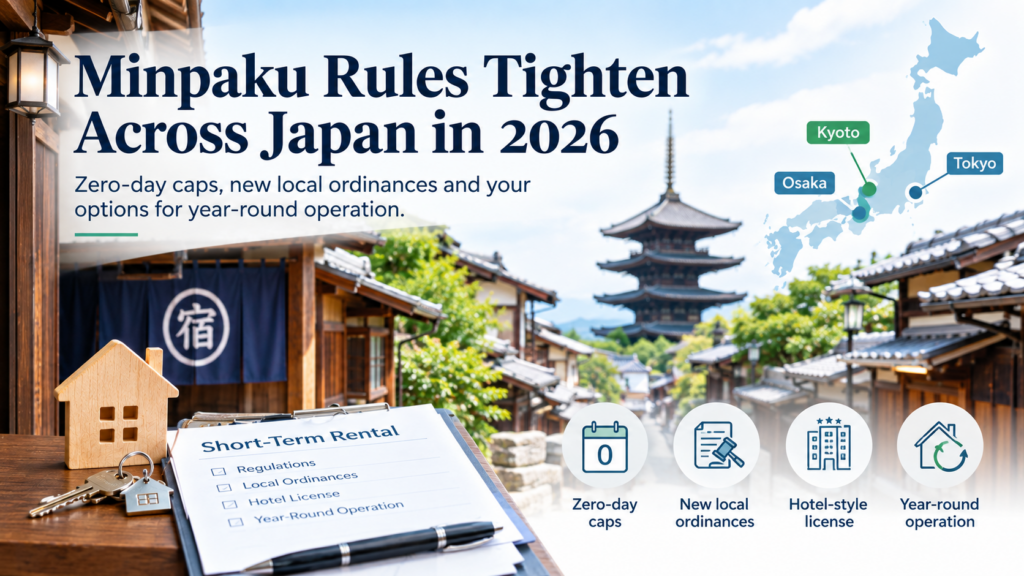
In June 2026 the Japan Tourism Agency finally moved. Local governments may now set the annual operating limit for notified minpaku properties to zero days through their own ordinances. It is not a nationwide ban. The national 180-day ceiling remains. But the central government has stopped treating zero-day rules as inappropriate. Municipalities that decide the living or educational environment is under pressure now have clearer authority to act.
The result is a patchwork that is tightening in real time. For owners already operating or considering short-term rental, one practical question keeps coming up: is there a legal path to year-round operation that steps outside the minpaku day limits?
The National Shift
Until this year, local ordinances could shorten the 180-day window, restrict weekdays, or demand faster response times. Setting the number to zero was considered out of bounds. The July 2026 technical advice changed that. Cities and wards can now designate residential zones or areas near schools where minpaku may operate for zero days a year. Existing properties can be included after a grace period if problems have already appeared.
That is the framework. The actual rules are being written ward by ward and city by city.
Tokyo: The Densest Experiment
Tokyo’s 23 wards have never been uniform. Most already layered extra restrictions on top of the national law. 2026 accelerated the process.
Shinjuku Ward, which holds more registered minpaku than any other municipality in Japan, is preparing the sharpest cut. Officials plan to ban operations in residential-only zones and near schools. The ban is expected to cover both new and existing properties after a grace period, and could affect roughly half of the nearly 4,000 facilities in the ward. Commercial areas would see the annual cap fall from 180 to 120 days. The ordinance is aimed for summer 2027 after public comment and assembly review.
Taito Ward, home to Asakusa and Ueno, is moving on a faster track for new applications. Residential areas and certain school districts face a zero-day limit for new minpaku beginning in 2027. From October 2026 all properties will be limited to weekends and holidays.
Other wards have already tightened days, required resident managers, or restricted weekdays. Grandfathering varies. Some protect properties registered before a certain date. Others apply the new limits across the board. The practical lesson is simple: the national number no longer tells you much. You need the specific ward ordinance and the registration date of the property.
Kyoto: Protecting the Quiet Streets
Kyoto has always been stricter than most places. Residential zones already limited many minpaku to a short winter window. Citizen surveys in 2026 showed strong support for further limits—over 70 percent, and in some polls more than 80 percent, favored stronger regulation.
In late August the city presented a draft to its expert panel. The proposal would set operating days to zero for new minpaku in residential-only zones and industrial zones, regardless of whether the owner lives on site. Existing facilities would be spared that particular restriction. The city is also examining tighter on-site staffing rules for both minpaku and small inns under the Hotel Business Act. An ordinance is expected to reach the city assembly in February 2027.
For anyone considering converting a machiya or vacant house in a quiet residential district, the window is closing. The draft is not yet law, but the direction is clear.
Osaka: Special Zone Pathway Narrowed
Osaka City closed new applications under the national strategic special zone system in May 2026 after a rise in noise and garbage complaints. Existing special-zone properties can continue, but the easier long-stay pathway is no longer open to new entrants. The city is also preparing tighter structural and staffing requirements for properties operating under the Hotel Business Act, including fire-resistant construction standards and on-site staff in certain cases. Those changes are moving through the September assembly session with a target of October enforcement.
Converting from Minpaku to a Hotel-Style License
The main legal route out of the 180-day (or stricter local) limit is to obtain permission under the Hotel Business Act (旅館業法) instead of continuing under the Private Lodging Business Act. The lighter category most owners pursue is “simple lodging” (簡易宿所). Once approved, there is no annual day cap. You can operate year-round.
This is not an automatic upgrade or simple name change. It is a new application for a different legal status. The property must meet higher standards, and success is far from guaranteed—especially in pure residential zones.
Key Differences That Matter
- Days: Minpaku is capped (nationally 180, often less locally). Simple lodging has no annual limit.
- Zoning: Minpaku can often operate in residential zones. Hotel/simple-lodging use is generally prohibited in pure residential districts (第一種・第二種低層住居専用地域 and similar). Commercial, quasi-commercial, and many mixed-use zones are viable; residential-only zones usually are not.
- Building and safety: The building is treated as a lodging facility rather than a residence. Fire-safety equipment, evacuation routes, ventilation, sanitation, and room-size standards are stricter. Since a May 2026 joint notice from the Ministry of Health, Labour and Welfare and the Ministry of Land, Infrastructure, Transport and Tourism, even properties under 200 m² require an architect’s certificate confirming compliance with the Building Standards Act.
- Staffing and operations: Many municipalities now require rapid on-site or near-site response. Physical front desks are often no longer mandatory if ICT systems (video check-in, identity verification, 24-hour contact) plus a quick-response plan are in place, but local rules vary.
- Timeline and cost: Realistic end-to-end time is typically 3–6 months if renovations are modest; longer if structural work or a full building confirmation is needed. Costs depend heavily on the existing condition of the building.
Practical Steps to Convert
- Confirm zoning first
Check the city’s urban-planning map or visit the local building/zoning office. If the property sits in a zone that does not allow hotel or simple-lodging use, conversion is usually impossible without a rare zoning change. - Preliminary consultations
Meet with the local public health center (保健所) that handles Hotel Business Act permits, the fire department, and the building guidance office. Bring floor plans and the property’s registration documents. This stage often reveals whether the conversion is realistic before money is spent. - Assess and complete required upgrades
Typical work includes fire alarms, emergency lighting, extinguishers, improved ventilation or sanitation facilities, and any changes needed to meet minimum guest-room area rules (generally 3.3 m² per guest if capacity is under 10, or a total guest-room floor area of at least 33 m²). An architect is usually required for the compliance certificate on smaller buildings. - Obtain fire-safety compliance
The fire department issues a certificate after inspecting equipment and evacuation plans. This is a prerequisite for the health-center application. - Submit the Hotel Business Act application
File with the health center. Required documents typically include floor plans, the architect’s certificate (or building confirmation if over 200 m²), fire-compliance documents, sanitation management plans, and a fee (often in the range of several tens of thousands of yen). Local ordinances may add extra conditions such as neighbor notification or staffing plans. - On-site inspection and permit
Health-center and fire officials inspect the finished facility. Once the permit is issued you may operate year-round under the new license. Cancel or close the previous minpaku notification as required by the local authority.
Local rules differ, and 2026 changes (including the architect-certificate requirement for smaller buildings and tighter staffing expectations in places like Kyoto and certain Tokyo wards) continue to evolve. Many owners engage an administrative scrivener (行政書士) and architect early. The process is slower and more expensive than a minpaku notification, but it removes the day-count ceiling that is now shrinking in so many cities.
Not every property can make the switch. Residential-zone locations that worked under minpaku rules are frequently ineligible. Properties already close to commercial standards or in mixed-use zones have a clearer path.
What This Means for Owners
If you already hold a valid minpaku registration, the first question is whether your municipality is applying new limits to existing properties. Some are. Some are not. The answer lives in the local ordinance, not in the national law.
If you are thinking about converting a property, the calculation has changed. Residential zones in the places that attract the most tourists are the hardest under both frameworks. Commercial zones still offer more room in many Tokyo wards, but even those are seeing shorter annual caps for minpaku. Kyoto’s residential districts are becoming effectively closed to new minpaku notifications under the draft rules, and hotel-style conversion faces the same zoning barrier.
Good management still matters. Properties that respond quickly to complaints, handle trash correctly, and keep noise under control are the ones least likely to become the reason a ward decides zero days is necessary. That has always been true. The difference in 2026 is that the consequences of failure are now more permanent—and the alternative of a full Hotel Business Act license, while available in some locations, requires real investment in compliance.
We walk these neighborhoods regularly. We hear the same stories from neighbors that the ward offices hear. The pressure is real. The regulatory response is no longer theoretical.
Read More
- Converting Your Property into Airbnb (Minpaku) in Japan — The practical steps and local hurdles before the 2026 tightening.
- Japan Zoning Laws: What Property Buyers Need to Know — Why residential versus commercial zoning now decides more than ever.
- Property Management in Japan for Foreign Owners (2026) — How remote owners stay compliant as local rules change.
- Why Managing a Japanese Property From Overseas Can Be Difficult — The daily realities that regulations are trying to address.
Need Help Managing Your Property in Japan?
If you own a property that is already registered or you are weighing whether short-term rental still makes sense under the new local rules—or whether a Hotel Business Act conversion is realistic for your location—we are happy to look at the specific situation with you. Reach out for a free consultation at https://propertymanagementkyoto.com/contact/.