
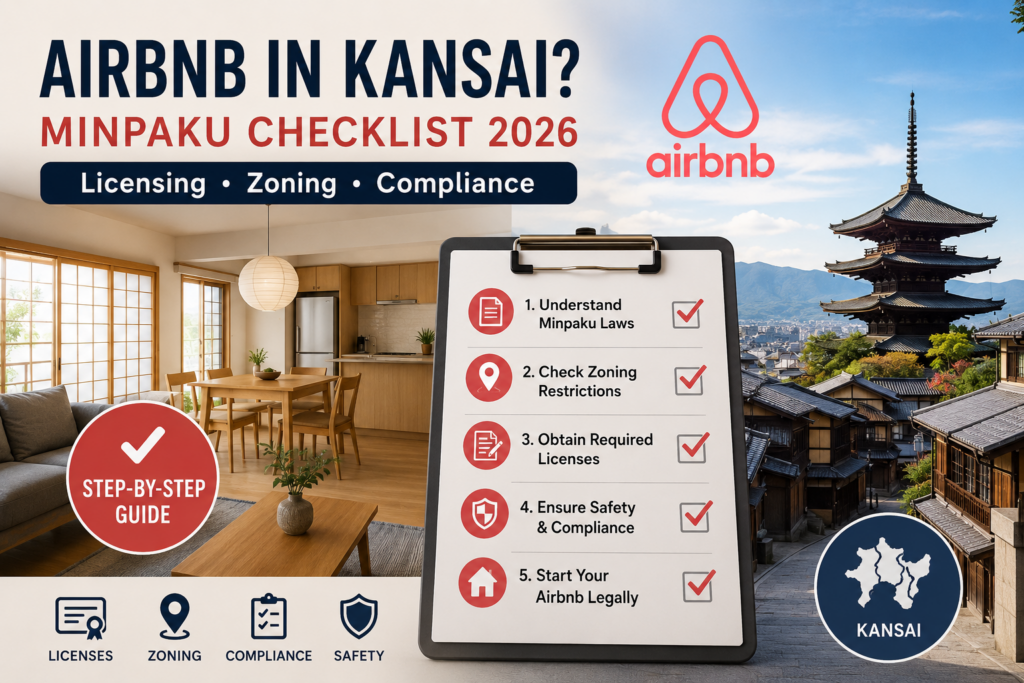
Converting a long-term rental or vacant investment property into a short-term rental on Airbnb (or Booking.com and similar platforms) in Japan is feasible and can deliver higher yields in strong tourism locations — but it is heavily regulated. The key framework is the Private Lodging Business Act (住宅宿泊事業法), commonly called the Minpaku Law or Minpaku Shinpō, which has been in force since June 2018.
This guide focuses on the standard minpaku route (the most common and accessible path for investment properties) while also covering the main alternatives. Local rules often override or tighten the national framework, so treating this as a national checklist alone is not enough.
Understanding the Options: Minpaku vs Alternatives
There are three main legal pathways:
| Lodging Type | Annual Operating Days | Key Requirements | Best For |
|---|---|---|---|
| Standard Minpaku (Private Lodging Business Act) | Up to 180 days (national maximum; many municipalities impose lower limits or seasonal/weekday restrictions) | Notification (not a full license), basic residential facilities, fire safety | Investment properties, second homes, part-time operation |
| Simple Lodging / Hotel License (Inns and Hotels Act – kan-i shukusho or full ryokan/hotel) | 365 days | Full permission process, stricter building/fire/sanitation standards, often change-of-use | Full-time commercial operations |
| Special Zone Minpaku (Tokku Minpaku) | Often year-round (subject to local rules; sometimes minimum stay of 2 nights) | Available only in designated zones; certification process | Specific tourist-heavy areas (availability has tightened in places like Osaka) |
Note on Tokku Minpaku availability: Osaka City — which has historically accounted for the large majority of Special Zone minpaku registrations nationally — suspended new Tokku Minpaku applications as of May 29, 2026. Already-certified properties there can continue operating, but new investors in Osaka now need to choose between the standard minpaku route (180-day cap) or a full Hotel Business Act license (no cap, higher barrier to entry). Check current status directly with the municipality before assuming this pathway is open.
For most investment properties, standard minpaku is the starting point because it avoids major change-of-use renovations in many cases. The 180-day national cap (calculated April 1–March 31) is a hard ceiling under the national law, but local ordinances can (and increasingly do) reduce it further — in some cases effectively to weekends only, specific seasons, or even zero days in certain residential zones.
Important 2026 development: Municipalities have greater flexibility to impose “zero-day” restrictions in residential areas to address noise, garbage, and neighborhood complaints. Always verify the current local ordinance for your specific municipality/ward before buying or converting.
Pre-Conversion Checklist: Feasibility First
Do these steps before spending money on renovations or assuming the property can operate as minpaku:
- Confirm ownership and usage rights
You must have legal right to use the property (title deed or lease with explicit landlord consent for minpaku). For condominiums/apartments: Check the building management rules (kanri kiyaku). Many (especially in Tokyo) explicitly prohibit short-term rentals. This is one of the most common deal-killers. - Check zoning and local ordinances
National law allows residential zones for minpaku, but local rules frequently restrict or ban it in pure residential areas. Contact the local public health center (hokenjo) and municipal tourism/housing department. Ask specifically about operating day limits, weekday/seasonal restrictions, and any zero-day zones. High-restriction examples (subject to change): Certain Tokyo wards (weekends only or reduced days for owner-absent properties), Kyoto residential zones (often limited to roughly mid-January to mid-March). - Determine owner-present vs owner-absent classification
Owner-present (yanushi kyojū gata): Owner lives on-site during stays → lighter requirements. Owner-absent (yanushi fuzai gata): Owner not present or guest room area exceeds 50 m² → must appoint a licensed private lodging manager (jūtaku shukuhaku kanri gyōsha). Most pure investment properties fall here. - Assess basic facility eligibility
The property must function as a residence with: kitchen, bathroom, toilet, and washbasin/washing facilities. Guest rooms generally need at least 3.3 m² of floor space per guest (excluding certain shared or non-habitable spaces). - Fire safety preliminary assessment
Contact the local fire department (shōbōsho) early with floor plans. Requirements vary by size, layout, and owner-present/absent status but commonly include smoke detectors in rooms/hallways, fire extinguishers, marked evacuation routes, and (especially for owner-absent or larger properties) emergency lighting and exit signs. Obtain a Fire Law Conformity Certificate (Shōbō Hōrei Tekigō Tsūchisho) after inspection. - Model realistic finances
Factor in: 180-day (or lower) cap, management fees (typically 15–30% for owner-absent), cleaning, platform fees, utilities, maintenance, property tax, and income tax (non-residents face withholding). Net yields after costs and taxes are often much lower than gross projections. Aim for locations with strong tourism demand and fewer restrictions.
Conversion & Registration Checklist (Standard Minpaku Route)
Once feasibility is confirmed:
- Prepare floor plans and documentation — Detailed blueprints showing guest areas, facilities, and safety equipment locations.
- Install required safety and facility upgrades — Based on fire department guidance. Costs vary widely (hundreds of thousands to several million yen depending on the property).
- Notify neighbors (where required) — Many municipalities require advance notification or explanation to nearby residents. Document this.
- Appoint a licensed management company (if owner-absent) — Mandatory for most investment scenarios. The company handles guest support, complaints, cleaning coordination, and compliance.
- Submit the notification — Via the national Minpaku Portal (minpaku.mlit.go.jp) or local authority. Typical documents include: notification form, floor plans, Fire Law Conformity Certificate, proof of ownership/use rights, management contract (if applicable), and certificate of non-bankruptcy and written oath regarding disqualifications. Processing often takes a few weeks to a couple of months. Upon acceptance you receive a notification/registration number (todokede bangō).
- Display required signage — Post the official private lodging business sign and your contact/complaint information at the property.
- Set up operational systems — Guest register (names, addresses, occupations, dates; passport details for foreign guests without a Japanese address), preserved for the required period. Bi-monthly (every two months) usage reports to the prefectural governor (nights, number of guests, nationality breakdown). Complaint response system (reachable contact, often 24-hour capability via manager). House rules in Japanese and English (quiet hours, waste sorting, etc.).
- List on platforms — Airbnb and others require the valid notification number and supporting documentation. Listings without it will be blocked or removed.
Ongoing Compliance & Operations Checklist
- Track operating days carefully against the applicable limit (national or local).
- Maintain hygiene, ventilation, and cleanliness standards.
- Handle foreign guest identity verification and any police reporting requirements.
- Submit periodic reports on time.
- Respond promptly to complaints.
- Renew or update registrations/management contracts as required.
- Comply with tax obligations (income tax, possible consumption tax above thresholds, local accommodation taxes in some areas). Non-residents typically need a tax representative.
Cost Considerations (Rough Ranges)
- Registration itself: Often low or free (local fees vary).
- Fire safety equipment and inspection: Variable; can be significant.
- Professional help (administrative scrivener for paperwork, management company setup): Commonly ¥100,000–¥300,000+ for registration support.
- Renovations/furniture: Highly property-specific (from modest for already-habitable units to millions of yen for akiya or major upgrades).
- Ongoing management: 15–30% of revenue is typical for full service.
Common Pitfalls to Avoid
- Buying or renovating before confirming local rules and building bylaws.
- Underestimating the impact of the day cap and local restrictions on revenue.
- Skipping professional local help (especially as a foreign or non-resident owner).
- Operating without a valid notification number.
- Ignoring neighbor relations or complaint handling.
Final Recommendations
Start with thorough due diligence on the specific property’s municipality and building rules — this single step filters out most non-viable conversions. Engage a local administrative scrivener (gyōsei shoshi) experienced in minpaku and a licensed management company early. For pure investment plays aiming at year-round income, evaluate whether a simple lodging license is realistic (higher cost and complexity but no 180-day national cap).
Regulations continue to evolve, particularly at the municipal level in popular tourist cities. Always cross-check the latest information with the official Minpaku Portal (mlit.go.jp/kankocho/minpaku), your local public health center, and fire department.
This checklist synthesizes the national framework with practical realities drawn from current guidance and common investor experiences. Success comes from treating compliance as foundational rather than an afterthought — do the research first, and the conversion becomes a manageable project rather than a costly surprise.
Need help managing your Kyoto or Japan investment property?
Whether you’re converting to minpaku, already operating short-term rentals, or looking for reliable full-service property management, the team at Property Management Kyoto specializes in supporting local and overseas owners. From compliance and guest operations to maximizing occupancy and handling day-to-day issues, we take the stress out of property ownership in Japan.
Visit propertymanagementkyoto.com today to learn how we can help manage your property.