
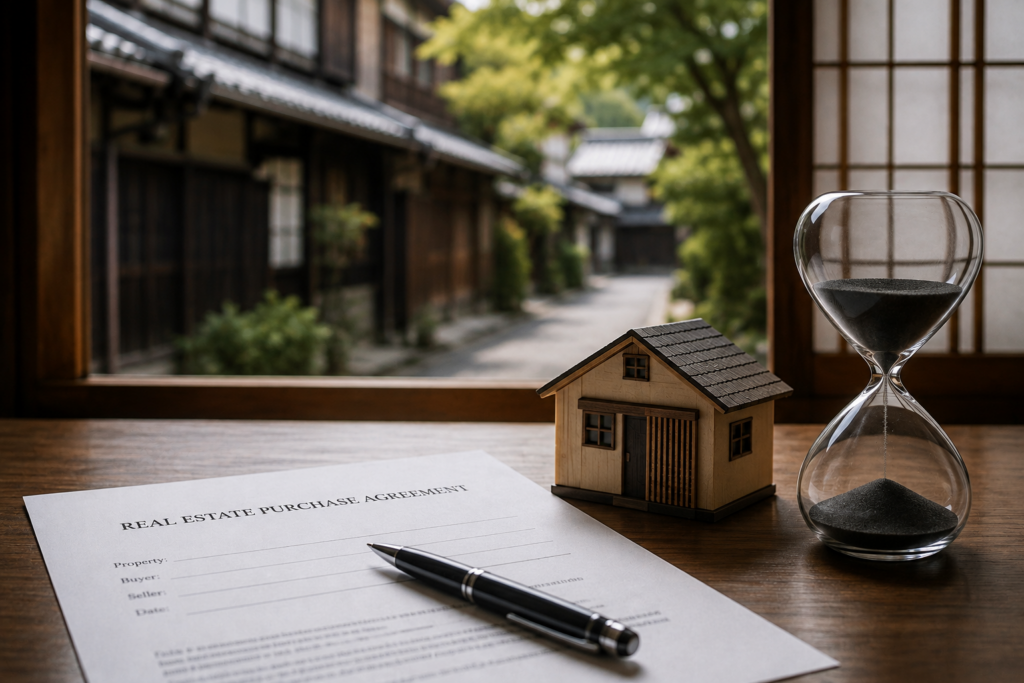
We have sat across from overseas buyers more than once and watched the same realisation settle in. They had just signed a purchase agreement for a house in Kyoto or Shiga, the ink still fresh, and they asked the question almost every foreign buyer eventually asks:
“So… do I have a cooling-off period?”
The short answer is usually no. The longer answer is more useful.
The rule that almost no one expects
Japan does not give ordinary home buyers a general right to change their mind after signing. The broad consumer cooling-off system under the Specified Commercial Transactions Act (the one that covers door-to-door sales, telemarketing, and certain service contracts) explicitly excludes ordinary real-estate purchases.
What exists instead is a narrow, specialised protection written into the Real Estate Brokerage Act (宅地建物取引業法), Article 37-2. It is limited, technical, and easy to miss if you are not looking for it.
When the cooling-off right actually applies
All of the following conditions must be true at the same time:
- The seller is a licensed real-estate broker (宅建業者) selling the property in its own name (自ら売主).
- The buyer is not a licensed real-estate broker.
- The offer or the contract was made at a place that is not the broker’s “office etc.” — for example a café, a hotel lobby, a temporary tent, or the buyer’s home when the broker initiated the visit.
- The property has not yet been handed over and the full purchase price has not yet been paid.
- The buyer sends a written notice of cancellation within eight days of the day they received a proper written explanation of the cooling-off right and how to exercise it.
If those five boxes are ticked, the buyer can cancel unilaterally. No reason is required. The broker cannot demand damages or a penalty, and any money already paid must be returned promptly. Any clause in the contract that tries to waive or limit this right is void.
That is the entire protective system.
When the cooling-off right does not exist or becomes invalid
Most of the situations overseas buyers actually encounter fall into the “does not apply” category.
- The seller is a private individual. Even if a real-estate agent is mediating the deal, the cooling-off provision only covers cases where the licensed broker itself is the seller. Private-to-private sales (the majority of used houses and many akiya) have no statutory cooling-off period at all.
- The contract was signed at the broker’s office, model room, or other registered business location. Once you sit down at their desk and sign, the special protection disappears.
- You, the buyer, asked the broker to come to your home or office to explain and sign. If the meeting at your place was at your request, the law treats it as if it had happened at their office.
- Eight days have already passed since you received the proper written cooling-off notice.
- You have taken possession of the keys and paid the full price. Once both delivery and full payment are complete, the right ends even if the eight days have not yet run out.
In short, the moment the transaction looks like a normal, considered purchase between adults who had time to think, the cooling-off door closes.
Why the rule is written this way
Japanese real-estate law assumes that buying a house is a serious, high-stakes decision that should not be reversible on a whim. The special cooling-off rule exists only for the relatively rare situation in which a professional seller catches a non-professional buyer in a setting where calm reflection is difficult — the classic high-pressure, off-site sale. Once the buyer has had the chance to sit in the broker’s office, or has requested the meeting themselves, the law decides they have had their opportunity to think.
That design protects consumers from ambush sales while still giving sellers and the market reasonable certainty once a contract is properly concluded.
What this means in practice for overseas buyers
If you are buying a used house or an akiya from a private owner, treat the contract as final the moment you sign it. There is no statutory safety net. The only ways out are the ordinary contractual remedies (handing over the deposit as cancellation money before the seller starts performance, or proving fraud, serious misrepresentation, or a major hidden defect).
If you are buying a new property or an investment unit directly from a developer or licensed seller, pay close attention to where the contract is signed and whether you received the formal cooling-off notice. Those details decide whether you still have eight days or whether the deal is already locked.
We have seen buyers assume they had the same cooling-off rights they enjoyed in their home country and then discover, after a difficult second thought, that Japanese law simply does not offer that cushion. Better to know the boundaries before the pen hits the paper.
Read More
Related reading for anyone navigating a Japanese property purchase:
Real Estate Fees in Japan: What Buyers Need to Know
The full list of costs that appear at contract and settlement — agency fees, stamp tax, registration, and the rest.
Japan Zoning Laws: What Property Buyers Need to Know
How land-use categories and building restrictions quietly shape what you can actually do with a property after you own it.
Property Management in Japan for Foreign Owners (2026)
What changes once the purchase is complete and you become an overseas owner responsible for the property from abroad.
Akiya Explained: Japan’s 9 Million Vacant Homes Decoded
Why so many empty houses come onto the market and what the practical realities look like for foreign buyers.
Need Help Managing Your Property in Japan?
Property Management Kyoto helps overseas owners look after Japanese homes, vacant houses, and akiya across Kyoto, Shiga, Osaka, Nara, and Kobe.
If you are in the middle of a purchase, reviewing a contract, or simply want a clear local perspective before you sign, contact us for a free consultation. We can help you understand exactly where you stand under Japanese rules.