
Non-resident owners of Japanese property must appoint a tax administrator. Here’s how the process works for fixed-asset tax and income tax in 2026.
We have watched more than one overseas owner discover, usually a little too late, that Japanese tax notices do not travel well across borders. Fixed-asset tax bills arrive by post, written in Japanese, addressed to the property. When the owner lives overseas and has no one registered to receive them, the notices simply go unanswered. Penalties begin, and in the worst cases the process can lead toward forced collection.
The legal solution is straightforward: appoint a tax administrator (納税管理人). This person or company becomes the official domestic point of contact for tax matters.
Why Non-Resident Owners Need One
If you do not have a Japanese address and you own real estate, earn rental income, or otherwise have Japanese tax obligations, you are generally required to appoint a tax administrator. The role covers two distinct systems:
- National taxes (mainly income tax on rent or capital gains, and sometimes consumption tax) handled through the National Tax Agency / local tax office (税務署).
- Local taxes, especially fixed-asset tax (固定資産税) and city-planning tax (都市計画税), handled by the municipality where the property sits.
Without a registered administrator, official notices cannot be delivered reliably. That is the practical risk that matters most to remote owners.
Who Can Serve as Tax Administrator
The administrator must have a Japanese address. They can be:
- An individual (a relative, friend, or trusted contact living in Japan)
- A corporation
- A professional such as a tax accountant (税理士), judicial scrivener, or property management company that offers the service
Many overseas owners use their property management company or a tax accountant because the same party already handles related paperwork and can coordinate payments. There is no legal requirement that the administrator be a licensed professional, but reliability and clear communication are essential.
The Two Separate Filings
This is the part that most often confuses people. There is not a single universal form.
For national taxes (income tax, etc.)
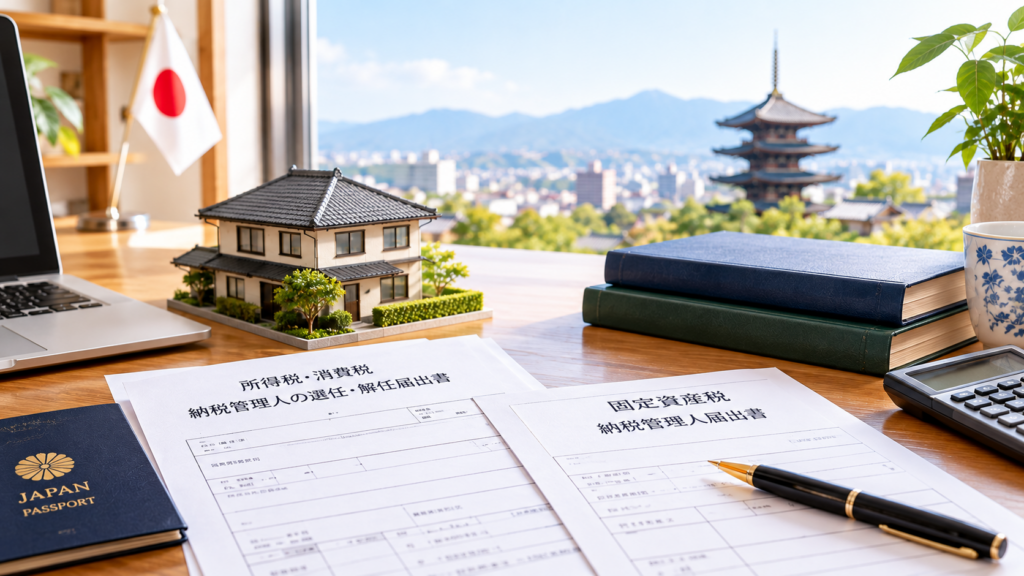
Submit the “Notification of Appointment or Dismissal of Tax Administrator for Income Tax and Consumption Tax” (所得税・消費税の納税管理人の選任・解任届出書) to the tax office that has jurisdiction over your tax location (usually linked to the property or your last Japanese address). The form is available from the National Tax Agency and can often be filed by mail or, in some cases, via e-Tax.
For fixed-asset tax
Submit the municipality’s own tax-administrator notification form to the city, ward, or town office where the property is located. Forms and exact requirements vary by local government. In Tokyo’s 23 wards the process runs through the metropolitan tax offices; elsewhere it is handled by the municipal tax section.
Both filings should include the administrator’s full name, Japanese address, and contact details, along with basic identification for the owner. Once accepted, future tax notices for those categories are sent to the administrator.
Practical Steps
- Choose a reliable person or company with a Japanese address who is willing to receive mail, communicate with you, and arrange payment of the taxes (you will normally reimburse them).
- Complete the relevant notification forms. Your administrator can often help prepare or submit them.
- File the national-tax form with the appropriate tax office and the local-tax form with the municipality.
- Keep copies of the submitted documents and confirmation of acceptance.
- Arrange how the administrator will pay the taxes (usually from a Japanese bank account you fund, or by reimbursement after payment).
It is best to complete the appointments before or shortly after becoming a non-resident. The process can still be done from overseas, but it is smoother when the paperwork is handled while communication channels are still easy.
What the Administrator Actually Does
The role is administrative rather than advisory. The administrator:
- Receives tax notices and official correspondence
- Can file returns or pay taxes on your behalf (depending on the authority you give them)
- Acts as the contact point the authorities will use
They do not automatically become your full tax advisor unless you separately engage them for that service. Clear written instructions about payment authority and reporting expectations help avoid misunderstandings.
Common Points of Friction
- Assuming one form covers everything — national and municipal systems are separate.
- Choosing someone who does not reliably check mail or respond.
- Forgetting to update the appointment if the administrator changes address or you change representatives.
- Overlooking the fixed-asset tax side while focusing only on income-tax requirements.
Once the system is in place, the ongoing work is usually modest: the administrator receives the annual fixed-asset tax notice (typically issued in spring/early summer), pays the installments according to your instructions, and forwards any important correspondence.
For owners who also rent the property, the same administrator or management company can often coordinate the 20.42 % withholding that applies to rental income paid to non-residents, keeping the tax side more coherent.
Read More
- Property Management in Japan for Foreign Owners (2026) — The broader framework of remote ownership obligations.
- Property Management Costs in Japan: 2026 Guide — How management fees interact with tax and administrative services.
- Why Managing a Japanese Property From Overseas Can Be Difficult — Why local representation matters for paperwork and deadlines.
- Cost of Owning a House in Japan: Kansai Guide — Ongoing ownership expenses that the tax administrator helps keep current.
Need Help Managing Your Property in Japan?
If you own property in Kyoto, Shiga, or the wider Kansai region and need help appointing a reliable local tax administrator or coordinating the related management and compliance steps, we are happy to discuss the practical options with you. Reach out for a free consultation at https://propertymanagementkyoto.com/contact/.