
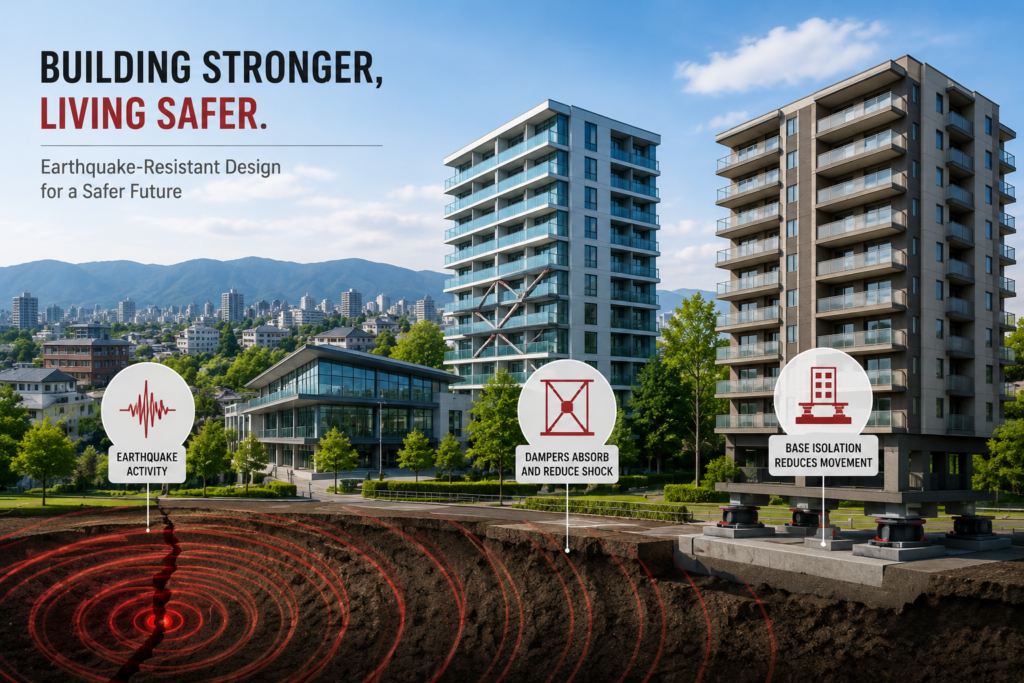
If you own or manage property in Japan, you already know the ground here doesn’t sit still for long. Japan sits at the junction of four tectonic plates — the Pacific, Philippine Sea, Eurasian, and North American — which makes it one of the most seismically active countries on Earth. Since 1900, Japan has recorded roughly two dozen earthquakes of magnitude 8.0 or higher, including the magnitude 9.1 Tōhoku earthquake of 2011, one of the most powerful ever measured anywhere in the world.
The chart below breaks down significant Japanese earthquakes by decade and magnitude. A few things jump out: large earthquakes aren’t a recent phenomenon, they’ve been a near-constant feature of every decade for over a century, and the apparent increase in recent decades partly reflects better detection and reporting, not just more activity.
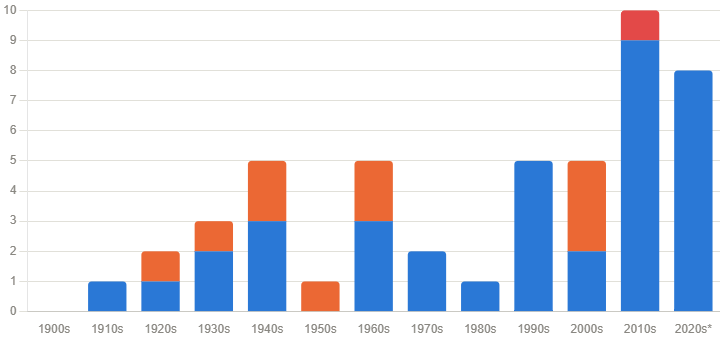
Source/credit line: Compiled from Wikipedia’s “List of earthquakes in Japan” (sourced from USGS and JMA data). Not an exhaustive seismic catalog.
(Note: this data is based on a curated list of significant M7+ earthquakes, not an exhaustive seismic catalog — early 1900s figures are likely undercounted due to limited instrumentation at the time.)
Given that backdrop, it’s no accident that Japan has become the world leader in earthquake-resistant construction and disaster technology. Here’s a look at how the country prepares its buildings — and how that history has shaped the way we approach property management today.
How Japan’s building codes evolved
The single biggest factor in whether a building survives a major earthquake isn’t its age exactly — it’s which building code it was built under.
Japan’s modern seismic code history breaks into a few key moments:
- Pre-1950: Little to no formal seismic design standard.
- 1950 Building Standards Act: Japan’s first nationwide seismic design code, introduced after WWII.
- 1981 “New Seismic Standard” (Shin-Taishin): A major overhaul following lessons learned from earlier quakes, requiring buildings to withstand a magnitude 6–7 event without collapsing. This is the dividing line engineers and inspectors still refer to today — “pre-1981” versus “post-1981” construction.
- 2000 revision: Further tightened standards for wooden structures after the 1995 Great Hanshin (Kobe) earthquake exposed weaknesses in timber-frame homes.
Time and again — from Kobe in 1995 to Kumamoto in 2016 to Noto in 2024 — the pattern repeats: buildings constructed before 1981 account for a disproportionate share of collapses and severe damage, while post-1981 structures generally perform far better, even in intensity-7 shaking. That’s why the construction year of a property is one of the first things we check when assessing earthquake risk for a home we manage.
For more on how we evaluate a property’s structural history, see our building age and risk assessment guide.
The technology that keeps buildings standing
Beyond code compliance, Japan has pioneered several engineering techniques that are now studied and copied worldwide.
Base isolation (menshin) Rather than bolting a building rigidly to its foundation, base-isolated structures sit on rubber-and-steel bearings or sliding pads that let the building move independently of the ground. During an earthquake, the foundation shakes while the structure above barely sways. This technology is common in hospitals, government buildings, and increasingly in high-end residential towers.
Dampers and vibration control Many modern Japanese high-rises use oil dampers, tuned mass dampers, or steel dampers built into the frame to absorb and dissipate seismic energy, reducing the sway that can cause structural fatigue or make upper floors uninhabitable during aftershocks.
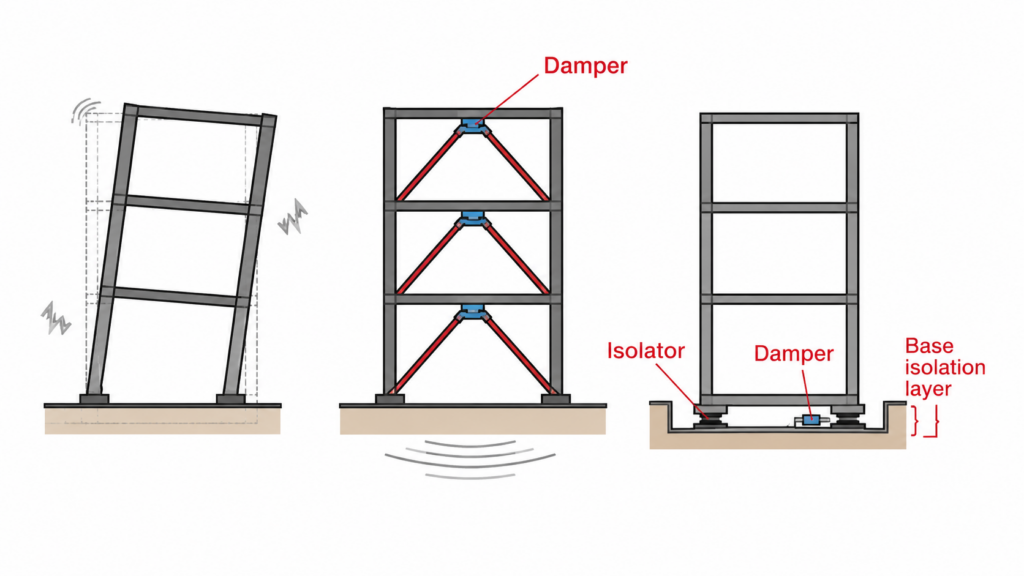
Flexible and reinforced frames Techniques like CFT (concrete-filled steel tube) columns and reinforced timber joints allow a structure to flex and absorb energy rather than crack and fail outright.
Earthquake early warning (EEW) The Japan Meteorological Agency’s early warning system can detect an earthquake’s initial P-waves and broadcast alerts — sometimes with just seconds to tens of seconds of warning — before the more destructive S-waves arrive. Those seconds are enough to stop trains, halt elevators, and give people time to take cover.
Seismic retrofitting For older buildings that predate 1981, retrofitting techniques — adding steel bracing, base isolation, or reinforced walls — can bring a structure much closer to modern seismic performance without a full rebuild. If you manage or own a pre-1981 property, this is worth investigating.
What this means if you own property here
All of this technology matters, but it doesn’t eliminate risk — it manages it. Even well-built, code-compliant homes can suffer real damage in a major event: cracked walls, shifted foundations, damaged roof tiles, or compromised utilities that aren’t always visible from a quick walkthrough.
That’s where we come in.
How Property Management Kyoto helps after an earthquake
If a property we manage is affected by an earthquake, our team can be on-site quickly to carry out a full structural and safety inspection, documented with a detailed photo report covering:
- Visible structural damage (cracks, shifting, roof and tile displacement)
- Interior damage assessment room by room
- Utility and safety checks (gas, water, electrical)
- A written summary you can use for insurance claims, tenant communication, or your own records
Because we’re already familiar with the property, we can move faster than a first-time inspector and give you a clear, honest picture of what needs attention versus what can wait.
If you’d like to know more about how our inspection and reporting process works, visit our post-disaster inspection services page, or get in touch directly through our contact page to add your property to our monitoring list.
Japan’s relationship with earthquakes isn’t going away — but a century of engineering innovation, combined with responsive, well-documented property management, means it’s a risk you can plan for rather than just react to.