
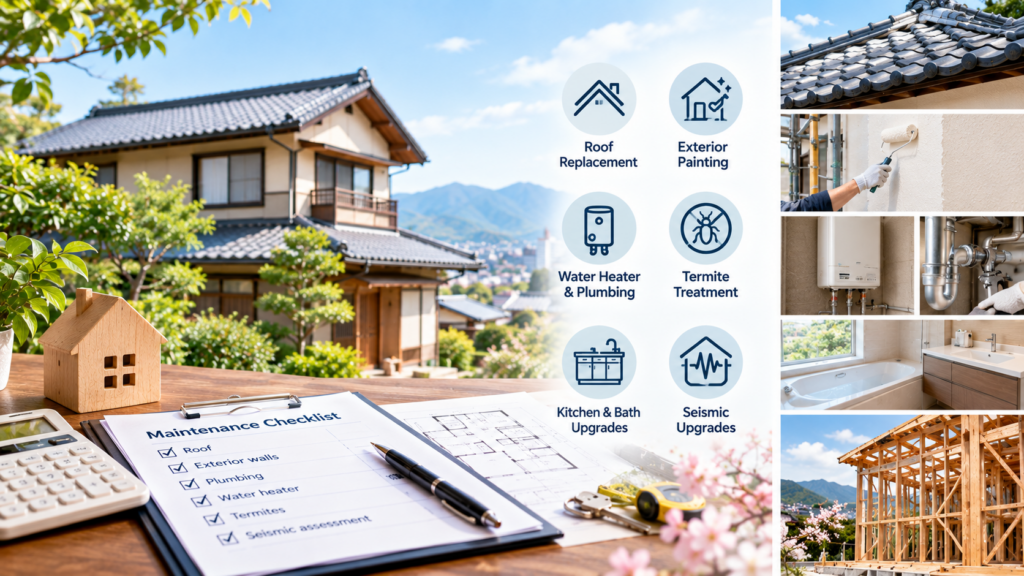
We have walked through more used houses in Kyoto and Shiga than we can easily count. Some feel solid the moment you step inside. Others carry the quiet evidence of deferred care: a soft spot under the tatami, a roof tile that has shifted, a faint mustiness that never quite leaves. Age alone does not decide the cost of ownership. Maintenance history and the decisions you make after purchase do.
For overseas owners considering a used house, understanding the realistic repair cycle is one of the most useful pieces of preparation.
Roof Replacement and Maintenance Intervals
The roof is usually the largest single exterior cost. Japanese roofs vary widely, and the interval depends on the material.
Traditional clay tile (瓦) can last 50–100 years or more if the underlying structure stays sound. The tiles themselves rarely need full replacement, but the underlayment, ridge mortar, and supporting boards typically require attention every 20–30 years. Partial re-pointing or re-laying of the ridge often costs ¥500,000–¥1,500,000 depending on size and access. A full re-roof with new underlayment can run ¥1,000,000–¥2,500,000 or higher for a typical two-storey house.
Slate (化粧スレート / コロニアル) is common on houses from the 1980s onward. Painting is usually needed every 7–15 years. Full replacement or cover methods become realistic around 20–35 years. Costs for a full re-roof on a 30-tsubo house often fall in the ¥800,000–¥1,800,000 range.
Metal roofs (especially galvalume / ガルバリウム) are lighter and more earthquake-friendly. They generally last 20–40 years with proper coating. Painting intervals are longer than slate; full replacement costs are often comparable to or slightly lower than slate.
Many owners of older houses choose to switch from heavy tile to lighter metal during a major roof project. The weight reduction can meaningfully improve seismic performance.
Other Recurring Repairs
Beyond the roof, several systems follow predictable cycles:
- Exterior walls: Painting or re-siding every 10–15 years. Typical costs ¥600,000–¥1,500,000 including scaffolding.
- Water heaters: 10–15 years. Replacement ¥150,000–¥400,000 depending on type and installation.
- Plumbing and drainage: Older houses frequently need pipe work or outdoor drain clearing. Individual jobs range from tens of thousands of yen to several hundred thousand.
- Termite treatment: Recommended every 5 years in many regions. ¥100,000–¥200,000.
- Bathroom, kitchen, and toilet updates: Often required or desired between 15–30 years. Costs vary widely but can easily reach ¥1,000,000–¥3,000,000 for a full water-area refresh.
- Foundations and structural timber: Moisture, settlement, or termite damage can appear in older wooden houses. Costs depend entirely on the findings of a proper inspection.
A practical planning figure many owners use is setting aside ¥200,000–¥400,000 per year on average for a typical used detached house, knowing that actual spending comes in larger lumps rather than evenly.
Buying Older Homes and Earthquake Resistance
Japan’s seismic standards changed significantly in June 1981. Houses built before that date follow the old seismic code (旧耐震基準). Those built afterward follow the new standard (新耐震基準), with further refinements in later decades.
Pre-1981 wooden houses are not automatically unsafe, but they were designed to different criteria. Collapse rates in major earthquakes have historically been higher for buildings from that era. A professional seismic diagnosis (耐震診断) is the only reliable way to know the actual condition of a specific house. Diagnosis costs typically range from ¥50,000–¥150,000 for a standard wooden house.
If reinforcement is recommended, typical retrofit costs for a two-storey wooden house fall in the ¥1,000,000–¥3,000,000 range, though complex cases run higher. Common measures include adding diagonal bracing, improving connections between structural members, strengthening the foundation, and reducing roof weight. Many municipalities offer subsidies that can cover a meaningful portion of diagnosis and retrofit costs.
Roof replacement and seismic work often overlap usefully. Switching from heavy tile to a lighter metal roof during a re-roof can form part of a broader seismic upgrade and may qualify for local support programs.
Post-1981 houses generally meet stronger baseline requirements, but age, maintenance history, and any later modifications still matter. An inspection remains worthwhile on any used house, regardless of the construction year.
Practical Approach for Overseas Owners
When evaluating a used house, budget for a thorough inspection that includes the roof structure, underlayment, exterior walls, drainage, and seismic assessment if the building is pre-1981 or shows signs of concern. Factor the likely near-term repair cycle into the purchase decision rather than treating it as a later surprise.
Once you own the property, regular inspections — even when the house is vacant or only occasionally occupied — remain the most effective way to keep costs predictable. Small issues caught early rarely become the large ones that dominate ownership expenses.
We see the pattern repeatedly. Houses that receive steady, informed attention remain comfortable and relatively economical to keep. Those left alone for years accumulate problems that eventually demand concentrated spending.
Read More
- How to Prevent Mold in Vacant Kansai Homes — Moisture control that protects both structure and interior.
- Is Your Akiya Ready for Typhoon Season? — Seasonal risks that accelerate roof and exterior wear.
- Why Checking for Termites (Shiroari) Is Essential for Akiya Owners in Japan — One of the most common hidden costs in older wooden houses.
- Cost of Owning a House in Japan: Kansai Guide — The broader picture of ongoing ownership expenses.
Need Help Managing Your Property in Japan?
If you own or are considering a used house in Kyoto, Shiga, or the wider Kansai region and want clear local support with inspections, maintenance planning, or coordination of larger repairs, we are happy to look at the specific property with you. Reach out for a free consultation at https://propertymanagementkyoto.com/contact/.