
We have stood in empty rooms that should have been earning rent and in occupied ones where a small leak had already stained the ceiling because no one on the ground was checking. The difference between a rental property that runs smoothly and one that becomes a slow drain is almost always the quality of the local management.
For overseas owners, Japanese property management for rental homes is not the same job as looking after a vacant akiya. Tenants introduce a whole layer of daily reality: contracts, complaints, move-ins, move-outs, and the quiet pressure of keeping the income flowing while staying on the right side of Japanese landlord-tenant rules.
The Core Difference: People Are Living There
A vacant house needs protection from humidity, pests, and the weather. A rental home needs all of that plus someone who can answer the phone when a tenant reports a broken heater at 9 p.m., or when the building management association wants a signature on a repair decision.
Japanese residential leases fall into two main types. Ordinary leases (普通賃貸借) give tenants strong security of tenure. Fixed-term leases (定期借家) have a clear end date and are often preferred by owners who want more control. Getting the contract type right at the start matters. A good management company handles the drafting, explains the differences, and makes sure the paperwork matches the owner’s goals.
Tenant screening is another area where local knowledge is hard to replace. Credit checks, guarantor systems, and the practical realities of who will actually pay on time vary by city and by property type. Remote owners rarely have the network or the language access to do this well on their own.
What a Management Company Typically Handles
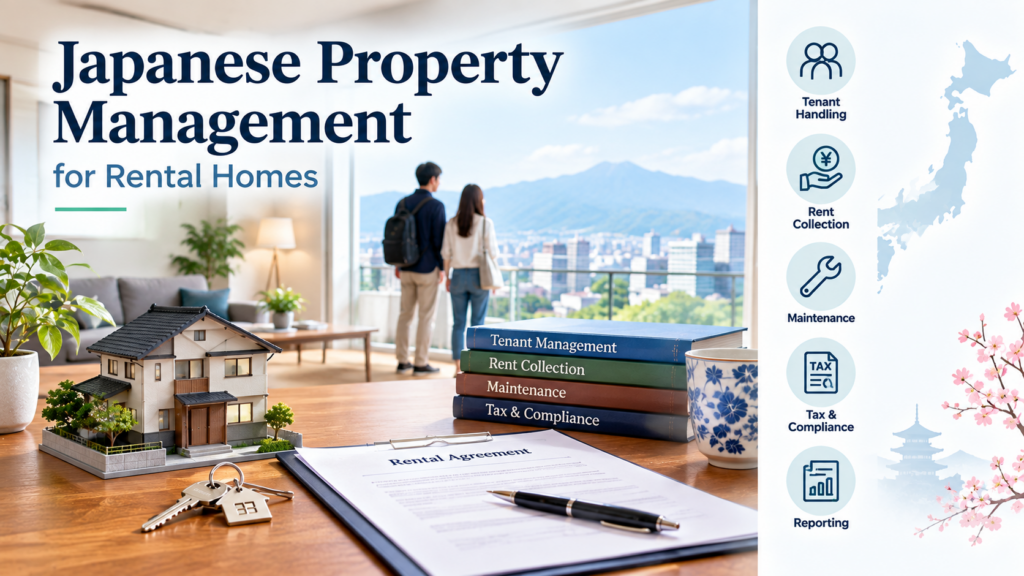
For a rental property the standard package usually includes:
- Finding and screening tenants
- Preparing and renewing lease agreements
- Collecting rent and chasing arrears
- Coordinating routine and emergency maintenance
- Move-in and move-out inspections, including deposit reconciliation
- Communicating with tenants and with the building management association (if the property is a condominium)
- Sending regular reports — ideally in English — showing rent received, expenses, and any issues
For non-resident owners two extra items are almost non-negotiable. First, the company (or an affiliated tax professional) needs to handle the 20.42 % withholding tax that applies to rental income paid to people living outside Japan. Second, someone must be registered as the domestic contact person in the property registry and act as tax administrator (納税管理人) so that fixed-asset tax notices and other official mail do not go unanswered.
International remittances of the net rent are another practical detail. Not every Japanese management company is set up to send money overseas cleanly and on a predictable schedule. Asking about this early saves frustration later.
The Quiet Work That Protects the Asset
Even when a property is occupied, the building itself still needs attention. Gutters clog. Outdoor drains back up after heavy rain. Small roof issues become larger ones if no one is looking. A competent manager schedules periodic inspections that go beyond the tenant’s reported problems and catches the things tenants may not notice or may not bother to report.
In Kansai the seasonal cycle is predictable: humidity and mold risk in the rainy season and summer, typhoon season from late summer into autumn, and colder, drier months that bring different maintenance questions. Rental management that ignores these rhythms eventually costs the owner more in repairs and lost rent.
What Overseas Owners Should Ask
When you speak to a potential management company, a few questions separate the ones that understand foreign owners from those that do not:
- Do you handle the 20.42 % withholding and tax administrator duties?
- Can you remit net rent to an overseas bank account, and what are the fees and timing?
- Will reports and important notices arrive in English?
- How do you handle emergency repairs when the owner is in a different time zone?
- What is your process for tenant complaints and for coordinating with condominium management associations?
The answers reveal whether the company treats overseas ownership as a normal part of the business or as an awkward exception.
Rental Management Versus Vacant-Home Care
Vacant-home management focuses on preservation: inspections, ventilation, pest control, garden upkeep, and storm readiness. Rental management adds the human layer of tenants and income. Many owners move between the two states — a property sits empty for a period, then is rented, then becomes vacant again. The best local partners can handle both without forcing the owner to change companies every time the situation shifts.
We see the practical results every month. Properties with steady, professional management keep tenants longer, suffer fewer expensive surprises, and produce cleaner financial records. Properties left to informal arrangements or to the hope that “someone will call if there’s a problem” tend to generate the opposite.
Read More
- Property Management Costs in Japan: 2026 Guide — How fees are typically structured for both vacant and rental properties.
- Property Management in Japan for Foreign Owners (2026) — The broader framework of remote ownership.
- Why Managing a Japanese Property From Overseas Can Be Difficult — The practical frictions that management is designed to remove.
- How Often Should You Inspect an Empty House in Japan? — Inspection rhythms that still matter when a property is tenanted.
Need Help Managing Your Property in Japan?
If you own a rental home in Kyoto, Shiga, or the wider Kansai region and want clear, English-language management that handles tenants, rent, maintenance, and the local compliance steps, we are happy to look at the specific situation with you. Reach out for a free consultation at https://propertymanagementkyoto.com/contact/.