
Exploring Japan’s Newest UNESCO World Heritage Site
Hidden among the rice fields of southern Nara lies one of the most important places in Japanese history. This peaceful rural landscape was once home to Japan’s earliest imperial capitals, where the country’s first centralized government took shape more than 1,400 years ago. Best explored by bicycle through quiet villages, ancient temple grounds, and archaeological parks, Asuka-Fujiwara offers a fascinating journey into the origins of the Japanese nation.
In July 2026, UNESCO recognized this extraordinary landscape by inscribing the Ancient Capitals of Asuka and Fujiwara (飛鳥・藤原の宮都) as Japan’s 27th World Heritage Site and its 22nd cultural World Heritage Site. After spending nearly two decades on UNESCO’s Tentative List, this collection of 19 archaeological sites in Nara Prefecture finally received the global recognition it deserves.
Unlike many of Japan’s famous historical destinations, Asuka-Fujiwara is not defined by towering castles or magnificent wooden temples. Instead, it invites visitors to imagine the past through palace foundations, ancient burial chambers, and landscapes that have changed surprisingly little over the centuries.
Why Visit Asuka-Fujiwara?
Whether you’re a history enthusiast or simply looking for somewhere different to explore in Kansai, Asuka-Fujiwara offers a unique experience.
- Visit Japan’s newest UNESCO World Heritage Site
- Explore the birthplace of Japan’s imperial government
- Walk through ancient palace ruins and one of Japan’s oldest Buddhist temples
- Enter one of Japan’s most impressive stone burial chambers
- Cycle through beautiful countryside rich in history
- Discover a destination still overlooked by many international visitors
A Quiet Landscape with Monumental History
Unlike the grand temples of nearby Nara or the impressive castles built centuries later, most of Asuka-Fujiwara’s important buildings were constructed from wood and disappeared long ago. What remains today is often hidden beneath grassy fields or preserved as carefully excavated stone foundations.
Yet this understated landscape is precisely what makes the area so special. Between the late sixth and early eighth centuries, this was the political and cultural heart of Japan, where ideas from China and the Korean Peninsula helped transform a loose federation of powerful clans into a centralized imperial state.
Visitors can step inside cool stone burial chambers, walk across palace foundations hidden beneath open fields, and stand where some of Japan’s most dramatic political events unfolded. Rather than simply viewing history from behind museum glass, Asuka-Fujiwara allows visitors to experience the landscape where it actually happened.
Key Sites That Tell the Story
Ishibutai Kofun
Ishibutai Kofun is one of Japan’s most spectacular ancient tombs. Its enormous stone chamber—constructed from more than thirty massive stones weighing an estimated 2,300 tons—was revealed after the earthen mound covering it was removed centuries ago.
Most historians believe it was built as the tomb of Soga no Umako, the influential statesman who played a central role in introducing Buddhism to Japan. Standing inside the chamber today, it is difficult not to wonder how such enormous stones were transported and assembled without modern machinery.
Asukadera
Just a short distance away stands Asukadera, Japan’s first full-scale Buddhist temple. Commissioned by Soga no Umako and completed in 596, it marked the beginning of Buddhism as an important force within Japanese society.
Although today’s main hall dates from the Edo period, the temple’s famous Great Buddha (Shaka Nyorai), cast around 609, still contains portions believed to be original. Unusually for a temple housing such an important national treasure, visitors are permitted to photograph the statue.
Asuka Palace Site
The Asuka Palace Site, including the remains of Itabuki Palace, served as the political centre of Japan during one of its most transformative periods.
It was here that the famous Isshi Incident of 645 took place. Prince Naka no Ōe (later Emperor Tenji) and his ally Nakatomi no Kamatari assassinated Soga no Iruka, ending the dominance of the Soga clan and clearing the way for the Taika Reforms, which fundamentally reshaped the Japanese government.
Standing among the palace ruins today, with Asukadera and Amakashi Hill visible nearby, visitors can almost picture the dramatic events that changed the course of Japanese history.
Asuka Mizuochi Site: Japan’s First Water Clock
Not far from Asukadera lies the Mizuochi Site, the ruins of Japan’s first water clock (rōkoku), built around 660 on the orders of the same Prince Naka no Ōe. Water flowed down a series of stepped tanks and copper pipes, with the falling level used to measure the hours, which were then announced to the court.
Today only the foundation stones remain, but the site is a quiet reminder that Asuka-Fujiwara was also where Japan began to formally measure and administer time itself, an achievement still marked every June 10 on Japan’s Time Commemoration Day.
Takamatsuzuka and Kitora Kofun
Two remarkable painted tombs showcase the artistic and scientific achievements of the Asuka Period.
Takamatsuzuka Kofun, discovered accidentally in 1972, contains the famous “Asuka Beauties” murals depicting elegantly dressed women, alongside guardian deities and an astronomical ceiling. The original paintings were removed for conservation, completed in 2020, and exceptional reproductions are now displayed in the nearby museum.
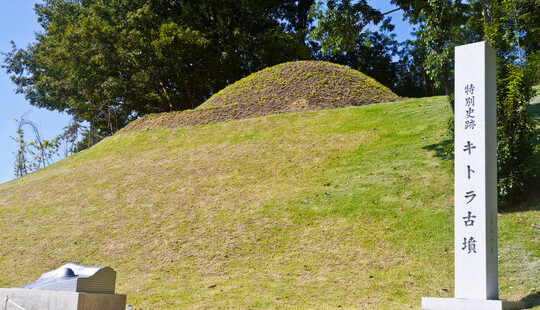
Nearby Kitora Kofun preserves Japan’s only complete set of the Four Guardian Deities murals and one of East Asia’s oldest surviving astronomical ceiling maps, reflecting sophisticated astronomical knowledge introduced from the Asian continent.
Sakafuneishi and the Mysteries of Asuka
Not every archaeological site has revealed its secrets.
The Sakafuneishi Site features a large carved stone with channels and basin-like depressions whose original purpose remains uncertain. Scholars have proposed everything from ritual ceremonies to medicinal preparation and sake production.
Excavations uncovered an elaborate water system that includes a turtle-shaped stone basin, suggesting the area may have been used for sacred purification rituals connected to imperial ceremonies.
Other mysterious carved stones scattered throughout Asuka—including Turtle Stone and the Monkey Stones—continue to intrigue archaeologists and visitors alike.
Fujiwara-kyō: Japan’s First Planned Capital
In 694, the imperial court relocated a short distance north to Fujiwara-kyō, Japan’s first fully planned capital based on Chinese urban design principles.
Laid out on an orderly grid with broad avenues, government offices, and an immense palace complex covering nearly one square kilometre, Fujiwara-kyō represented a bold new vision for the Japanese state.
Although the capital lasted only sixteen years before moving to Heijō-kyō (present-day Nara) in 710, its design became the blueprint for later capitals, including Kyoto.
Today, little remains above ground, but standing in the wide-open fields of Fujiwara Palace still conveys the remarkable ambition behind Japan’s first purpose-built capital city.
Why Asuka-Fujiwara Matters
The importance of Asuka-Fujiwara extends far beyond its archaeological remains.
It was here that Japan witnessed:
- the emergence of imperial rule under the title Tennō (“Emperor”)
- the establishment of centralized government
- the introduction and institutionalization of Buddhism
- advances in astronomy, timekeeping, and engineering
- the adoption of Chinese-inspired city planning and administrative systems
- the blending of continental knowledge with existing Japanese traditions
These developments laid the foundations for the Japan we know today, bridging the gap between the monumental kofun era and the flourishing capital of Nara.
Just as importantly, the surrounding landscape remains largely rural. Rice fields, quiet villages, gentle hills, and the three sacred mountains of Yamato create a setting where 1,400 years of history feel surprisingly close. Visitors can get remarkably close to many of the archaeological remains, including entering certain stone burial chambers—an experience rarely possible at other UNESCO World Heritage Sites in Japan.
Visiting Tips
The best way to experience Asuka-Fujiwara is by bicycle. Rental bicycles are available near Asuka Station on the Kintetsu Line, and quiet country roads connect most of the major archaeological sites.
Allow at least one full day to explore the area, although history enthusiasts could easily spend two days visiting the museums, temples, and lesser-known sites.
Spring cherry blossoms and autumn colours provide particularly beautiful scenery, while museums and visitor centres help bring the archaeological remains to life through detailed exhibitions and reconstructions.
If you’re planning a wider Kansai itinerary, you may also enjoy reading our guides to Kyoto, Lake Biwa, and other historic destinations throughout the region on Property Management Kyoto.
Planning a Longer Stay in Kansai?
If you’re exploring Kansai with the idea of buying, renovating, or inheriting a traditional Japanese home, we’ve written a number of practical guides that may help.
Some of our most popular articles include:
- Buying an akiya (vacant home) in Japan
- Understanding Japanese property ownership laws
- Caring for traditional homes
- Living in Kyoto and the wider Kansai region
Visit https://propertymanagementkyoto.com to browse our growing collection of articles on Japanese homes, real estate, and life in Kansai.
How We Can Help Manage Your Home While You’re Away
Many people who visit Asuka-Fujiwara fall in love with rural Japan and eventually purchase a holiday home, inherited family property, or akiya in the Kansai region. However, leaving a house vacant for months at a time can quickly lead to problems.
Regular inspections help identify issues such as leaks, mould, termites, storm damage, or unauthorized entry before they become costly repairs. Japanese municipalities may also classify neglected vacant homes as problematic, potentially leading to additional taxes or legal obligations.
At Property Management Kyoto, we provide practical property management services for owners who live overseas or elsewhere in Japan. Depending on your needs, we can:
- Carry out regular property inspections
- Ventilate rooms and monitor humidity
- Check for leaks, pests, and storm damage
- Collect mail and report any issues
- Coordinate cleaning, maintenance, and repairs with trusted local contractors
- Help keep your property in good condition until your next visit
Whether you own a traditional farmhouse, an akiya, or a second home in the Kansai region, our goal is to give you peace of mind while you’re away.
Learn more about our services at https://propertymanagementkyoto.com or contact us to discuss how we can help care for your property.
Final Thoughts
Unlike Japan’s famous castles or towering temples, Asuka-Fujiwara asks visitors to imagine rather than simply admire. The rewards are immense.
Every palace foundation, ancient tomb, weathered stone, and quiet country lane tells part of the story of how Japan became a nation. For travellers interested in history, archaeology, or discovering somewhere beyond the usual tourist trail, Asuka-Fujiwara is one of the country’s most remarkable destinations—and now, officially, one of the world’s most important.
If you’re looking for a place where Japanese history feels tangible rather than distant, few destinations can match the quiet significance of Asuka-Fujiwara.