

Kyoto City has pushed back the start date of its landmark vacant home tax by one year. If you own an unoccupied property here — an inherited family home, a holiday house, or an investment property you manage from abroad — this delay changes your planning window, but it doesn’t change the fact that the tax is still coming.
Here’s what actually changed, what the tax involves, and what foreign owners should do with the extra time.
What changed
The tax, officially called the Non-Residential Housing Utilization Promotion Tax (非居住住宅利活用促進税), was originally due to begin in fiscal year 2029 (Reiwa 11). Kyoto City has now confirmed the start has been pushed back one further year, to fiscal year 2030 (Reiwa 12), with liability based on a property’s occupancy status as of January 1, 2030.
The city has attributed the delay to the time needed to build the systems required to administer the tax, rather than to any change in policy direction. In other words, this is a delivery delay, not a change of heart — the tax is still going ahead.
Quick recap: what the tax actually does
- It applies only to homes inside Kyoto City’s urbanized areas (市街化区域). Properties outside these zones aren’t affected.
- It targets homes that are nobody’s primary residence — vacant houses, holiday homes, and second homes. A registered address alone doesn’t decide this; the city looks at whether someone genuinely lives there day-to-day.
- The amount owed is based on two components: 0.7% of the building’s assessed value, plus a land-based charge (0.15–0.60%, depending on the land’s assessed value relative to floor area). It isn’t a flat annual fee.
- On average, the city expects the new tax to add roughly half of a property’s existing annual fixed asset and city planning tax bill — though the real number depends heavily on location and value.
- Exemptions and relief exist for: homes below a set assessed value (temporarily, for the first five years), homes actively being marketed for sale or rent, homes genuinely run as a rental business, historically significant machiya, and temporary absences (job transfers, hospitalization, overseas assignments up to five years, and similar circumstances).
- Inherited properties get a three-year collection deferral from the date of death, which is waived entirely if the home is put back into use within that window.
- Payment, once it starts, is expected in four annual installments.
Why Kyoto is doing this at all
Kyoto is a city with unusually strict building and preservation regulations, which has made it hard to build enough new housing to keep pace with demand — even as tens of thousands of homes sit empty. The tax isn’t primarily designed to raise revenue; it’s designed to nudge owners toward selling, renting, or actually living in properties that would otherwise sit vacant indefinitely. It’s the first tax of its kind in Japan aimed specifically at both true vacancies and underused second homes at the municipal level, and other cities are watching closely to see how it plays out.
The scale of the problem behind the policy
Kyoto City’s own housing survey data shows why officials are motivated to act. Vacant homes in the city climbed steadily from the early 2000s, peaked at roughly 114,290 in 2013, and have declined only modestly since — sitting at 105,300 as of the most recent 2023 survey (a vacancy rate of 12.5%, still meaning roughly one in eight homes in the city sits empty).
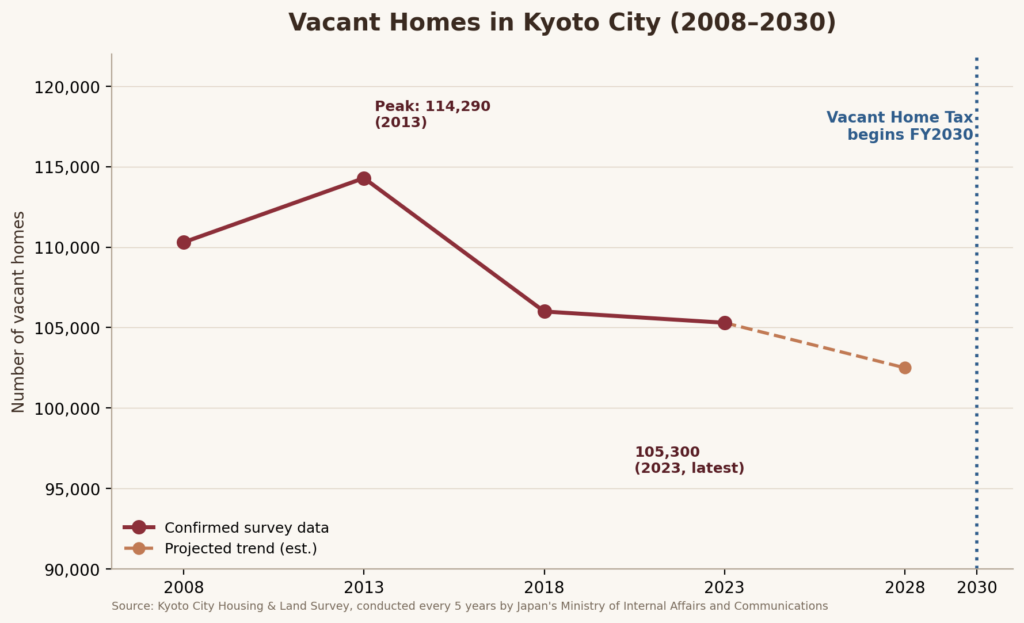
Source: Kyoto City Housing and Land Survey (住宅・土地統計調査), an official count conducted every five years by Japan’s Ministry of Internal Affairs and Communications. The 2028 figure is a projected trend, not an official count — the next survey will be conducted that year, with results published after.
What this means if you own a property here — especially from abroad
You have more runway, but not a reprieve. A one-year delay is meaningful if you’re mid-way through deciding whether to sell, renovate, or start renting out a property — but it’s not a reason to put off a decision entirely. Whatever you were planning to do before 2029 now simply needs to happen before January 1, 2030 instead.
“Vacant” is judged by actual use, not paperwork. If you’re managing a property remotely and it currently sits empty between visits, that status is what the city will assess — regardless of what’s on file. The most reliable way to avoid the tax isn’t a workaround; it’s making the property genuinely lived-in, rented, or actively listed.
This is where professional property management earns its keep. Placing a long-term tenant, running the property as a compliant short-term rental, or simply keeping it in an active, well-documented state for sale or lease are all recognized paths to exemption. For an owner overseas, coordinating any of that — tenant screening, minpaku licensing, listing management, or liaising with the city if questions come up — is exactly the kind of groundwork that’s hard to do from another country without someone local handling it.
Don’t wait for 2029 to start planning. Exemptions like the marketing exemption only last twelve months from when marketing begins, and getting a property into rentable condition, licensed, or listed can easily take longer than owners expect — particularly for older homes needing renovation work first.
If you own a vacant or underused property in Kyoto and aren’t sure which category it falls into, or what your realistic options are before 2030, that’s exactly the kind of assessment we help owners work through.