
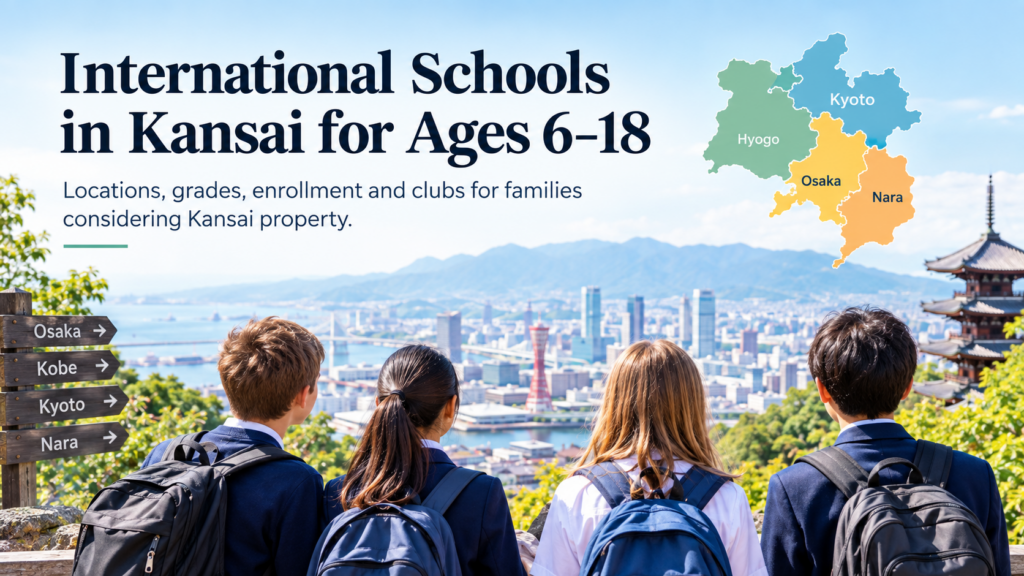
For families moving to Kansai with school-age children, choosing where to live often starts with the school commute. International schools are concentrated in a relatively small number of areas around Osaka, Kobe, Kyoto and Nara, which can make location just as important as the house itself.
For families considering a property purchase—or for owners hoping to attract long-term international tenants—knowing which schools serve children from elementary through high school can make a significant difference.
This guide focuses on schools relevant to children roughly ages 6–18 that offer an English-medium or substantial bilingual international pathway. It excludes daycare, English-language kindergartens and short-term English programmes.
Osaka Prefecture
Osaka has the largest concentration of international schools in Kansai.
Osaka International School of Kwansei Gakuin (OIS) in Minoh is a K–12 English-medium school offering the full IB pathway: PYP, MYP and Diploma Programme. The school has approximately 270 students representing more than 30 nationalities. Its shared campus with Senri International School provides opportunities for joint sports, music and other activities. OIS is particularly relevant for families looking at northern Osaka and the Minoh area.
Osaka YMCA International School (OYIS) operates across two Osaka City campuses. Younger students attend the Nakatsu campus, while older students move to Tosabori for the upper MYP and Diploma Programme years. OYIS offers the full IB PYP, MYP and DP pathway and has more than 300 students.
Abroad International School Osaka in Ikuno has expanded considerably and now offers Grades 1–12. Its IB Diploma Programme launched in August 2026, making it a newer full-school option for families looking for an English-medium pathway within Osaka City.
One World International School Osaka (OWIS) is another newer option in Ikuno. In 2026, the school serves students through Grade 9. Grade 10 is planned for 2027, followed by Grades 11 and 12 in 2028 and 2029. Families with older children should therefore check the current grade availability before choosing the area.
Hyogo Prefecture
Kobe is the other major international-school hub in Kansai, with several schools concentrated around Rokko Island and Suma.
Canadian Academy on Rokko Island is one of Kansai’s longest-established international schools, founded in 1913. It offers education from Pre-K through Grade 12 and provides a full IB pathway. The school is one of the larger international schools in the region and offers extensive athletics, arts, academic clubs and extracurricular activities, with boarding available for high-school students.
Marist Brothers International School (MBIS) in Suma offers education from Early Years through Grade 12. Its curriculum incorporates the IB PYP, MYP and Diploma Programme alongside California State Standards. More than 520 students attend the school, with a wide range of sports, academic clubs and student activities.
Kansai International Academy (KIA) in Kobe offers a Japanese-English bilingual international pathway from elementary through Grade 12. It follows the IB PYP, MYP and DP framework. KIA is worth considering for families who want an international education but are open to a bilingual environment rather than an English-only school.
Kyoto Prefecture
Kyoto has fewer international-school choices than Osaka or Kobe, but several options are important for families living in the wider Kyoto area.
Kyoto International School (KIS) in central Kyoto is now a full IB continuum school from Early Years through Grade 12. Grade 11 opened in 2025 and Grade 12 followed in 2026, completing the school’s upper-secondary programme. Its smaller size gives it a more intimate school environment than some of the larger international schools in Osaka and Kobe.
KIU Academy in Kyotanabe provides an English-language international education from elementary through high school. It follows an American-style Christian curriculum and is accredited by ACSI and WASC. Its location can make it relevant for families living south of Kyoto or toward the Osaka–Nara corridor.
Doshisha International School, Kyoto (DISK) in Kizugawa offers an English-medium secondary education using an MYP-based curriculum and the IB Diploma Programme. However, families need to be aware that the school has announced plans to close in 2029. New admissions are currently limited to existing grade levels, with no new students entering Grades 11 or 12. For families planning a long-term move to Kansai, this makes DISK a less secure option than the established schools listed above.
Nara Prefecture
Kansai Christian School in Heguri provides an American-style Christian education from Grade 1 through Grade 12. It is a smaller school than the major international schools in Osaka and Kobe and may be particularly relevant to families living in eastern Osaka, northern Nara or southern Kyoto.
What About Shiga and Wakayama?
Shiga and Wakayama have far fewer full K–12 English-medium international-school options than Osaka, Hyogo and Kyoto. Families living in these prefectures often need to consider a longer commute or look toward schools in the Osaka and Kyoto areas.
For families living around Otsu and Lake Biwa, for example, school-bus availability and train connections can be just as important as the distance shown on a map.
What International Schools Mean for Property Location
For property owners and buyers, the practical question is not simply which school is best, but where families can realistically live while maintaining a manageable school commute.
Properties within reach of established international-school corridors may appeal to families looking for longer-term accommodation, although school-bus routes, transport connections and housing quality all influence the decision. A property that looks attractive on paper may be considerably less practical if the daily journey to school is difficult.
School locations can therefore be another useful factor when assessing a Kansai property, particularly for overseas families who need an English-medium education for their children.
School fees, admission requirements, grade availability and transport arrangements can change from year to year, so families should always confirm current information directly with each school before making a housing decision.
Read More
- Costco in Kansai Japan: All 6 Locations — practical daily-life infrastructure for families
- The Busiest Train Stations in Kansai — commute realities that shape school choice
- Osaka’s Skyline: Skyscrapers & Rising Land Value — northern Osaka development near several schools
- Cost of Owning a House in Japan: Kansai Guide — the full ownership picture beyond school fees
Need Help Managing Your Property in Japan?
If you own (or are considering) a house or apartment in Kansai and want straightforward, on-the-ground support—whether the place sits near an international school corridor or farther out—reach out for a free consultation. We handle the inspections, the seasonal work and the practical details so you do not have to.