
Buying a house in Japan involves more than the advertised purchase price. Whether you are buying a Kyoto home, an investment property, or an older akiya, there are several costs to understand before you make an offer.
The largest and most visible additional cost is usually the real estate agent’s commission (仲介手数料). Japan regulates the maximum amount a licensed real estate agent can charge for a property transaction.
But brokerage is only one part of the total cost.
This guide explains how real estate commission works in Japan, gives examples using two current Kyoto-area property listings, and looks at some of the other costs buyers should budget for.
Real Estate Agent Commission in Japan
In Japan, a licensed real estate agent cannot simply charge whatever commission they want. The maximum brokerage fee is regulated by the Ministry of Land, Infrastructure, Transport and Tourism (MLIT).
For the standard calculation, the purchase price is divided into different price bands.
Maximum Standard Commission
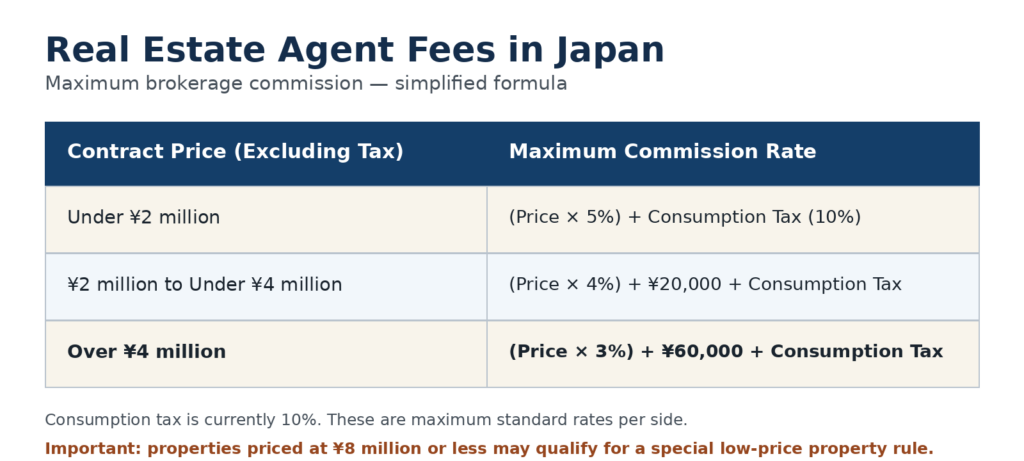
The simplified formula is:
- Under ¥2 million: 5% of the price + consumption tax
- ¥2 million to under ¥4 million: 4% of the price + ¥20,000 + consumption tax
- Over ¥4 million: 3% of the price + ¥60,000 + consumption tax
The calculation is based on the transaction price excluding consumption tax on any taxable portion of the property.
For properties over ¥4 million, this is why you will often see the Japanese real estate commission described simply as:
3% + ¥60,000 + consumption tax
At the current 10% consumption tax rate, that works out to 3.3% of the purchase price + ¥66,000.
These are maximum amounts. An agent can charge less, and the actual agreement between the client and agent determines the fee.
The legal framework is set by MLIT’s rules on the remuneration that licensed real estate businesses can receive for buying, selling and leasing property.
A Special Rule for Lower-Priced Properties
There is an important exception that is particularly relevant to buyers interested in older houses and akiya.
Since July 2024, properties priced at ¥8 million or less can fall under a special rule for “low-priced vacant houses and other properties.” Under the special rule, an agent may charge up to ¥330,000 including consumption tax from one side of the transaction, subject to the conditions of the rule.
This matters because the normal percentage calculation can produce a relatively small commission on an inexpensive house.
For example, the standard calculation on a ¥3 million property would be:
¥3,000,000 × 4% + ¥20,000 = ¥140,000
Plus 10% consumption tax = ¥154,000
The special rule can allow a higher maximum fee where it applies.
This is particularly important when looking at inexpensive rural houses and akiya. A ¥5 million house does not necessarily mean a tiny real estate commission.
How Much Would an Agent Charge on a Kyoto Property?
Let’s look at two actual properties currently listed on SUUMO.
These examples use the advertised purchase price and calculate the maximum standard brokerage commission. They are not estimates of the property’s other purchase costs.
Example 1: Kyoto City, Ukyo Ward
The first property is a used detached house in Narutaki Matsumotocho, Ukyo Ward, Kyoto City, currently listed at ¥26.99 million. SUUMO lists it as a 3LDK property with 93.79 m² of land and 88.28 m² of building space.
Because the price is over ¥4 million, the standard formula applies:
¥26,990,000 × 3% = ¥809,700
Add ¥60,000:
¥809,700 + ¥60,000 = ¥869,700
Add 10% consumption tax:
¥869,700 × 1.10 = ¥956,670
Maximum standard brokerage commission:
¥956,670
So a buyer or seller paying the maximum commission on this transaction could be looking at approximately ¥957,000 in brokerage fees.
Example 2: Muko City, Kyoto Prefecture
The second property is in Teradocho Sasaya, Muko City, near Higashi-Muko Station.
The current asking price is ¥9 million. SUUMO lists the property as a 3DK detached house with 42.55 m² of land and 44.83 m² of building space.
Although ¥9 million is relatively inexpensive compared with many Kyoto properties, it is still above the ¥8 million threshold for the special low-price property rule.
So the standard formula applies:
¥9,000,000 × 3% = ¥270,000
Add ¥60,000:
¥270,000 + ¥60,000 = ¥330,000
Add 10% consumption tax:
¥330,000 × 1.10 = ¥363,000
Maximum standard brokerage commission:
¥363,000
The interesting thing about this example is that the commission is already ¥363,000 on a ¥9 million property.
For someone searching for inexpensive Japanese property, the cost of buying an inexpensive house can therefore be quite different from simply looking at the advertised price.
Is the Agent Commission Paid by the Buyer or Seller?
This is an important point.
The maximum commission is calculated for each client who has engaged the agent. Depending on how the transaction is structured, an agent may receive a commission from the buyer, the seller, or both sides.
If you are buying a property through an agent, you should ask clearly:
“How much is the brokerage commission I will pay?”
Don’t assume that because the property is advertised by an agent, the seller automatically pays your commission.
The exact brokerage arrangement should be explained before you enter into the transaction.
Other Real Estate Costs in Japan
The brokerage fee is only one part of the cost of purchasing property.
Other expenses can include:
Stamp Duty
A real estate purchase contract is subject to 印紙税 (inshi-zei), or stamp tax.
The amount depends on the contract value and applicable tax rules.
Registration and License Tax
When ownership is transferred, registration with the Legal Affairs Bureau involves 登録免許税 (tōroku menkyo-zei).
The amount is generally calculated using the property’s assessed value rather than simply applying a percentage to the advertised purchase price.
Judicial Scrivener
A 司法書士 (shihō shoshi) normally handles the legal registration procedures.
Their fee is separate from the registration tax.
Real Estate Acquisition Tax
The buyer may also have to pay 不動産取得税 (fudōsan shutoku-zei).
This is a prefectural tax associated with acquiring real estate and is generally based on the property’s assessed value and the applicable tax rules.
Importantly, this isn’t necessarily a cost that appears immediately at the time you purchase the property.
Property Tax and City Planning Tax
Japan’s fixed asset tax (固定資産税) and, where applicable, city planning tax (都市計画税) are ongoing ownership costs.
At settlement, the buyer and seller may also agree to prorate these costs according to the ownership period.
Insurance
Buyers should also consider fire and earthquake insurance, particularly if they are financing the property.
Mortgage Costs
If you are taking out a mortgage, there can be additional costs for:
- Loan administration
- Guarantee fees
- Mortgage registration
- Insurance
- Bank charges
- Appraisal or related expenses
The exact costs depend heavily on the lender and loan.
How Much Should You Budget Beyond the Purchase Price?
There is no single percentage that applies to every property.
Several recent guides aimed at foreign buyers suggest budgeting somewhere around 6–10% above the purchase price for the various acquisition costs, although the actual amount can be lower or higher depending on the property, financing, taxes and other circumstances.
This is why comparing houses purely on their advertised prices can be misleading.
A ¥10 million house requiring significant renovation, professional fees and other expenses can ultimately cost considerably more than ¥10 million.
Likewise, a more expensive property may have proportionally lower additional costs in some categories because certain taxes are based on assessed values rather than the market price.
What About Foreign Buyers?
Foreign buyers generally need to consider the same Japanese property transaction costs as other buyers.
There isn’t a separate “foreigner real estate commission” simply because you aren’t Japanese.
However, buying from overseas can introduce additional practical issues.
You may need help with:
- Japanese-language documents
- Power of attorney
- Property inspections
- Contract explanations
- Bank transfers
- Registration
- Local government correspondence
- Finding contractors
- Managing the property after purchase
This is particularly important if you are buying an older house or an akiya and don’t plan to live in Japan full-time.
Before buying an inexpensive property, it is worth understanding not just how much the house costs, but what condition it is in and what you will need to spend after completion.
Our guide to [Japanese akiya and vacant homes] can help explain why the purchase price is only one part of the decision.
Buying an Akiya? Watch the Fees Carefully
The special commission rules for properties priced at ¥8 million or less are especially relevant to the akiya market.
An inexpensive property can look extremely attractive when you see a listing for ¥3 million, ¥5 million or ¥7 million.
But you still need to consider:
- Brokerage
- Taxes
- Registration
- Legal fees
- Inspection
- Renovation
- Utilities
- Insurance
- Garden maintenance
- Ongoing property management
A cheap house isn’t necessarily a cheap house to own.
This is one reason we recommend looking at the total cost of ownership, rather than focusing only on the purchase price.
Buying a Property in Kyoto From Overseas
For overseas buyers, the costs are only part of the challenge.
You also need to consider what happens after you complete the purchase. Things like:
- Who will check the house?
- Who will deal with a leaking roof?
- Who will receive important mail?
- Who can meet a contractor?
- Who will notice if the garden becomes overgrown?
These questions are particularly important if you are buying a second home, an akiya or an older property that you will not occupy year-round.
Property Management Kyoto provides local property support for owners who need someone in Japan to help monitor and maintain their property.
If you’re buying property in Kyoto, Shiga or elsewhere in Kansai and expect to manage it from overseas, learn more about Property Management Kyoto.
Real Estate Fees: The Main Takeaway
The familiar 3% + ¥60,000 + consumption tax formula is a useful starting point, but it isn’t the whole story.
Before buying property in Japan, make sure you understand:
1. The maximum brokerage commission
2. Whether you are responsible for paying the agent
3. Stamp duty
4. Registration and judicial scrivener costs
5. Real estate acquisition tax
6. Property and city planning taxes
7. Insurance
8. Mortgage costs, if applicable
9. Renovation and maintenance costs
10. The costs of managing the property after you buy it
And if you’re looking at a property priced at ¥8 million or less, don’t automatically apply the standard percentage formula. The special low-price property rules may allow a different maximum commission.
The advertised price is only the beginning of the calculation.
Continue Reading About Owning Property in Japan
Buying property in Japan is about more than the purchase price. These guides cover some of the other issues that can matter to foreign owners.
Akiya Explained: Japan’s 9 Million Vacant Homes
Learn what Japan’s “9 million akiya” figure actually means and why not every vacant property is an abandoned house.
Read: Akiya Explained — Japan’s 9 Million Vacant Homes Decoded
Japan’s Aging Apartment Problem
Buying a condominium is different from buying a detached house. Learn why the age and management of a Japanese apartment building matter, particularly for overseas owners.
Read: Japan’s Aging Apartment Problem
Ten Things to Know About Co-Ownership
Thinking about buying property with family, friends or business partners? Understand how co-ownership works before you purchase.
Read: Ten Things to Know About Co-Ownership of Property in Japan
Need Help With a Japanese Property?
If you own or are considering buying a property in Kyoto, Shiga or elsewhere in Kansai, having someone local can make the process much easier.
Property Management Kyoto helps overseas owners with property inspections, maintenance coordination, vacant-home care and ongoing local support.